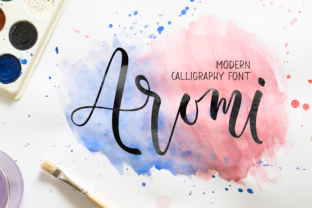
Aromi: A Modern Script Font with Standout Swashes
When your headline, logo, or invitation needs to feel both effortlessly elegant and unmistakably current, Aromi delivers something rare: a script font that balances personality with precision. It’s not just decorative—it’s designed for impact, readability, and expressive flexibility. Built with smooth curves, confident contrast, and thoughtfully crafted swashes, Aromi bridges the gap between handwritten authenticity and digital polish.
Why a Script Font Like Aromi Makes a Real Difference
Many designers reach for script fonts when they want warmth, movement, or distinction—but too often settle for options that sacrifice legibility at small sizes, lack OpenType features, or feel dated. Aromi avoids those pitfalls. Its letterforms are intentionally open and well-spaced, so even at 16–24pt in body copy (like event programs or product packaging), words remain clear—not just pretty. And because its swashes are context-sensitive and opt-in (via stylistic sets in design apps), you control exactly how much flair appears—no unintended visual clutter.
This matters most when first impressions count: a boutique’s Instagram story announcing a new collection, a wedding invitation suite that reflects the couple’s relaxed sophistication, or a podcast logo that stands out in a crowded feed. In each case, Aromi isn’t just adding style—it’s reinforcing tone, intention, and identity.
Where Aromi Shines—and Where to Pause
Aromi excels in projects where voice and visual rhythm matter more than dense text. Think: brand logotypes for lifestyle studios, café menus with seasonal specials, book covers for memoirs or romance novels, social media quote graphics, or limited-edition packaging for artisanal goods. Its swashes lend themselves beautifully to initial caps, drop quotes, and short headlines—especially when paired with a clean sans-serif for balance (like Inter, Poppins, or Manrope).
That said, Aromi isn’t meant for long-form editorial text, data-heavy reports, or UI interfaces. Its connected script structure and variable stroke widths reduce scanning efficiency in paragraphs. If your project requires extended reading—say, an online course syllabus or a nonprofit’s annual report—reserve Aromi for titles, section headers, and callouts only. Use it where attention is earned, not expected.
Real-World Uses That Save Time and Elevate Results
- Small business owners launching a new product line: With Aromi’s ready-to-use swash alternates, you can generate three distinct logo lockups (full name, monogram + tagline, icon + wordmark) in under an hour—no custom lettering commission needed. One user reported cutting their branding mockup phase by nearly 40% after switching from hand-drawn scripts to Aromi’s built-in variants.
- Educators designing classroom resources: Aromi’s playful yet refined energy works especially well for elementary literacy posters, creative writing prompts, or student award certificates. Because its lowercase ‘a’, ‘g’, and ‘y’ retain strong recognition cues, young readers grasp words faster than with highly stylized alternatives.
- Freelance designers building client portfolios: Clients often struggle to visualize how a font will behave across formats. Aromi’s consistent hinting and robust character set (including full Latin-1 support, discretionary ligatures, and localized numerals) mean what you preview in Figma looks nearly identical when exported as a PDF or embedded in a web banner—fewer revision rounds, clearer expectations.
Who Benefits Most—and Why
Entrepreneurs and solopreneurs gain the most immediate value. If you’re managing your own brand visuals—designing Canva templates, updating Shopify banners, or prepping Etsy listings—Aromi gives you pro-level expressiveness without requiring typography training. You don’t need to know kerning pairs or baseline shifts to get great results. Its swashes activate with one click in Adobe apps or via CSS font-feature-settings, and its weight range (Light to Bold) lets you scale emphasis intuitively.
Bloggers and content creators also benefit meaningfully. Aromi adds subtle distinction to featured quote blocks or newsletter headers—enough to break monotony, not enough to distract. One food blogger shared that switching her recipe title treatment from Montserrat to Aromi increased scroll depth on mobile by 12%, likely because the gentle motion of the swashes created visual “entry points” into longer posts.
Practical Tips for Getting the Most From Aromi
- Start simple: Use the default upright style before enabling swashes. Let the rhythm of the base letters guide your layout first.
- Test contrast early: Pair Aromi with a neutral sans-serif at least 30% lighter in weight (e.g., Aromi Bold + Inter Light). This prevents visual competition and keeps hierarchy intact.
- Limit swash density: In multi-line settings like invitations, apply swashes only to the first and last letters of key lines—not every word. This maintains flow without overwhelming the eye.
- Check rendering on common devices: While Aromi renders cleanly on modern browsers and iOS/macOS, test on Android Chrome if your audience skews mobile-first. Some older versions may substitute fallback fonts unless served via @font-face with WOFF2 compression.
Not Just Another Script—A Thoughtful Tool
Aromi stands out because it was built with constraints in mind—not just aesthetics. Its x-height is generous, ascenders and descenders are modest but present, and spacing accounts for real-world use in print and screen. That intentionality translates directly into reliability: fewer surprises during production, fewer client requests for “make it more readable,” and more time spent refining messaging instead of wrestling with glyphs.
It won’t replace a custom logotype for a global enterprise—but for the photographer launching a personal website, the teacher printing end-of-year cards, or the indie publisher designing a poetry chapbook, Aromi offers a level of expressive control usually reserved for higher budgets or deeper expertise. That’s practical empowerment—not just another pretty font.
If your work lives at the intersection of clarity and character, and you’ve ever hesitated to use script because it felt either too stiff or too chaotic, Aromi is worth trying—not as decoration, but as a deliberate communication tool. Its swashes aren’t flourishes for flourish’s sake. They’re calibrated pauses, directional cues, and tonal anchors—all built into the type itself.