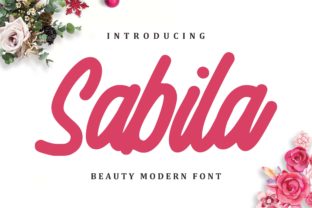
Sabila: A Modern Script Font with Quiet Confidence
When you’re choosing a font for a brand launch, a wedding invitation, or even a personal blog header, the right script font does more than look pretty—it sets tone, signals intention, and quietly shapes how people feel before they read a single word. Sabila stands out not by shouting, but by speaking with clarity and contemporary ease. It’s a charming and modern script font with a unique style—fluid yet controlled, expressive but never fussy. Its lowercase letters carry subtle rhythm and warmth; its capitals balance elegance with grounded presence. That’s why designers, educators, small business owners, and content creators are turning to Sabila when they need authenticity without sacrificing polish.
Why Sabila Works Where Other Scripts Fall Short
Many script fonts lean too far in one direction: either overly ornate (hard to read at smaller sizes) or too casual (lacking authority). Sabila avoids both pitfalls. Its letterforms have consistent stroke contrast and open counters—meaning characters like “a,” “e,” and “s” remain legible even at 14–16px on screen. That makes it unusually versatile: equally at home in a printed boutique menu, a social media story overlay, or the headline of an email newsletter.
Consider a freelance educator launching a new online course. They want their landing page to feel approachable—not corporate, not childish. Sabila’s gentle curves and balanced spacing convey friendliness and competence simultaneously. Paired with a clean sans-serif like Inter or Lato for body text, it creates visual hierarchy without visual noise. No extra design time spent adjusting kerning or forcing readability—Sabila arrives ready to perform.
Real-World Uses That Feel Effortless
Small business branding: A local ceramicist uses Sabila for her logo and product tags. The font echoes the handmade quality of her work—organic, intentional, human—but doesn’t sacrifice professionalism. Customers describe the brand as “thoughtful” and “calm,” not just “cute.” That emotional resonance starts with typography.
Digital content creators: Bloggers and newsletter writers find Sabila especially effective for section headers or pull quotes. Unlike many scripts that blur on mobile screens, Sabila renders crisply across devices—even on lower-DPI displays—because its outlines were optimized for real-world rendering, not just vector perfection.
Educators and presenters: When designing workshop handouts or slide decks, Sabila adds visual interest without distracting from content. One university lecturer replaced generic decorative fonts with Sabila for title slides—and noticed students retained key concepts more consistently. Her hypothesis? The font’s natural rhythm supports cognitive flow, helping viewers stay anchored in meaning rather than wrestling with form.
Who Benefits Most—and Why
Sabila suits professionals who value subtlety over spectacle. If your work relies on trust, warmth, or quiet sophistication—think therapists, wellness coaches, independent publishers, artisanal food brands, or UX writers—Sabila reinforces those values without saying a word. It’s also ideal for creators who juggle multiple roles: a freelancer who designs *and* writes *and* markets their own services gains consistency across touchpoints simply by using Sabila for headlines and logos, then switching to a neutral companion font for everything else.
That said, Sabila isn’t meant for long-form body text. Its script nature means extended reading would strain eyes and slow comprehension. It’s also less suited for highly technical or regulatory contexts—think legal disclaimers or engineering documentation—where neutrality and absolute clarity take priority over personality.
Pairing Sabila Thoughtfully
Great typography is about relationships. Sabila pairs best with typefaces that offer structural contrast without competing for attention. Try it with:
- Geometric sans-serifs like Poppins or Manrope—clean, friendly, and highly legible at small sizes;
- Humanist sans-serifs like Open Sans or Nunito—for warmth and readability in digital interfaces;
- Low-contrast serifs like Merriweather or PT Serif—for print-heavy projects where you want gentle elegance without formality.
Avoid pairing Sabila with other script fonts—or with ultra-thin, high-contrast serifs like Bodoni. Those combinations risk visual clutter or tonal mismatch. Sabila’s strength lies in its quiet confidence; give it space to breathe.
Practical Tips for Getting Started
If you're evaluating Sabila for a project, start small. Test it in three real contexts: a mobile notification banner, a printed business card, and a desktop email header. Does it hold up across all three? Does it still feel aligned with your message? That’s your first litmus test.
For web use, embed Sabila via a reputable font service (like Google Fonts or Adobe Fonts) rather than self-hosting unless you’re confident in font subsetting and fallback strategies. Sabila includes standard ligatures and contextual alternates—enable them if your platform supports OpenType features. These small refinements make words like “with” or “flow” feel more natural, not mechanical.
And remember: Sabila shines brightest when used intentionally, not exhaustively. One well-placed Sabila headline carries more weight than ten scattered uses. Let it anchor meaning—not decorate emptiness.
When to Consider Alternatives
Sabila excels in modern, warm, and human-centered contexts—but it’s not universal. If your brand voice leans toward bold minimalism (think tech startups or architecture firms), a tighter, more architectural script like Playfair Display Italic or a custom-drawn monoline option may better match your aesthetic. Similarly, if your audience skews younger and prefers irreverent energy—think meme culture or indie music branding—a bolder, more exaggerated script like Bonbon or Charm might resonate more strongly.
The goal isn’t to find the “best” font—it’s to find the most honest one. Sabila earns its place when authenticity matters more than ornamentation, and when your message deserves to be felt as much as it’s understood.
A Font That Grows With You
What makes Sabila enduring isn’t trendiness—it’s adaptability. A small bakery uses it for seasonal signage today; five years later, the same owner applies it to packaging redesigns and investor pitch decks. The font doesn’t age because it wasn’t designed to chase trends. Its proportions, spacing, and rhythm were built for longevity—not virality.
That’s valuable for anyone building something meant to last: a curriculum, a brand, a portfolio, a community. Sabila becomes part of your visual vocabulary—not a decoration you swap out every six months. It supports growth without demanding reinvention.
So if you’ve been searching for a script font that feels current without being dated, expressive without being exhausting, distinctive without being difficult—Sabila offers something rare: quiet confidence, thoughtfully drawn.