Chical: A Bold, Retro-Inspired Font for Modern Design Projects
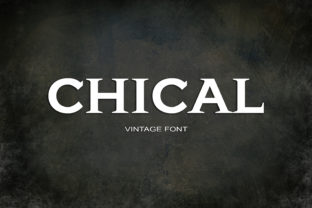
Chical is a newly released vintage font that draws deliberate inspiration from 1980s typography—think high-contrast letterforms, tight spacing, and confident geometry—but reimagined with contemporary precision. Unlike nostalgic revivals that lean heavily into kitsch or pixel-perfect emulation, Chical balances retro authenticity with functional clarity. Its bold weight is built-in, not added as an afterthought, giving it presence without sacrificing legibility at medium to large sizes.
What Sets Chical Apart From Other Retro-Inspired Fonts
Many fonts labeled “retro” or “vintage” rely on surface-level cues: distressed textures, uneven baselines, or exaggerated serifs. Chical avoids those shortcuts. Instead, it interprets 1980s typographic values—confidence, immediacy, structural assertiveness—through clean vector outlines and consistent stroke modulation. The uppercase ‘A’, for example, features a sharp, angular apex and open counter, echoing signage and album art of the era—but with tighter vertical metrics and improved spacing for digital use.
This distinction matters in practice. When used for headlines in editorial layouts or branding systems, Chical delivers visual impact without demanding excessive kerning adjustments or fallback styling. It’s designed to work *out of the box*, not just as a stylistic accent but as a primary typographic voice.
Fitness for Purpose: Where Chical Excels
Chical performs best in contexts where tone and identity carry equal weight to readability. Consider these real-world applications:
- Brand identities launching in lifestyle, music, or creative sectors—especially when aiming for energetic, self-assured positioning without leaning into irony or pastiche.
- Digital banners and social media graphics, where boldness and quick recognition are essential; its strong x-height and open counters hold up well even at smaller viewports.
- Print collateral like posters or packaging, where tactile presence and shelf impact matter—Chical’s weight distribution ensures ink coverage remains balanced across letterforms.
It’s less suited for long-form body text. Like most display-oriented fonts, Chical lacks the subtle rhythm, generous interlinear spacing, and nuanced glyph variants (small caps, old-style figures, discretionary ligatures) expected in extended reading environments. That’s not a flaw—it’s a design intention aligned with its category.
Comparing Chical With Broader Typographic Categories
Rather than comparing Chical directly to specific named fonts—which shift in availability, licensing, and perception over time—it’s more useful to situate it within broader typographic families and usage patterns.
Compared to geometric sans-serifs (e.g., Futura, Gotham), Chical shares structural discipline but introduces expressive tension: wider apertures, more pronounced contrast between thick and thin strokes, and a slightly compressed width that encourages dynamic line breaks. This makes it bolder in tone, yet more restrained than fully decorative display fonts.
Against neo-grotesques (e.g., Helvetica Neue, Inter), Chical trades neutrality for character. Where neo-grotesques prioritize adaptability and invisibility, Chical asserts itself—making it better for projects where typography must contribute meaning, not merely deliver information.
And unlike distressed or hand-drawn retro fonts, Chical doesn’t require additional layering or texture overlays to feel authentic. Its retro quality lives in proportion and silhouette—not in artificial aging. That reduces production complexity and improves cross-platform consistency.
Practical Tradeoffs to Consider
Every typeface involves compromises. With Chical, the main tradeoffs center on versatility and language support.
First, while Chical includes standard Latin characters and basic punctuation, its current release does not extend to extended Latin diacritics (e.g., Polish or Turkish accented letters) or non-Latin scripts. Designers working on multilingual projects—especially those targeting European or global audiences—will need to plan for fallbacks or pairing strategies.
Second, Chical’s bold nature means it doesn’t scale down gracefully below ~24px in UI contexts. Buttons, navigation labels, or caption text benefit from a companion text face. Successful implementations often pair Chical with a neutral, highly legible sans-serif—something with similar x-height and modest stroke contrast—to maintain typographic harmony without visual competition.
Third, licensing is worth verifying early. As a new release, Chical may be available under different terms depending on use case (web, desktop, app embedding). Some newer independent fonts offer flexible subscriptions, while others follow traditional perpetual-license models. Always confirm permitted uses before committing to a full rollout.
When Chical Is the Right Choice—And When It Isn’t
Chical is the right choice when your project needs a distinct, confident typographic anchor that communicates energy and intentionality—without relying on trend-driven gimmicks. It works especially well when paired with minimalist layouts, ample whitespace, and restrained color palettes. Think: a boutique record label launching a vinyl reissue series, a wellness brand emphasizing strength and clarity over softness, or a tech startup building a bold, human-centered interface.
Conversely, Chical may not be the best fit if your priority is maximum flexibility across formats and languages—or if your audience expects understated, institutional credibility (e.g., legal, academic, or financial services). In those cases, a more neutral, extensively tested type system—often built around a robust text face with multiple weights and optical sizes—will serve long-term usability and accessibility goals more reliably.
Also consider timing. Because Chical is newly released, it hasn’t yet accumulated the same breadth of real-world testing as established fonts. While its technical construction appears sound, designers adopting it for high-stakes, long-lived projects may want to pilot it across devices, operating systems, and assistive technologies before full deployment.
Making an Informed Decision
Choosing a font isn’t about finding the “best” one—it’s about matching typographic behavior to functional and expressive requirements. Chical stands out for its focused execution: it doesn’t try to be everything, and it doesn’t dilute its core idea to gain broader appeal.
To evaluate whether Chical fits your needs, ask yourself:
- Does the project benefit from immediate visual distinction—or does it rely on quiet reliability?
- Will the font appear primarily in large, short-form settings (headlines, logos, banners), or will it carry extended text?
- What languages and platforms must be supported—and does Chical meet those requirements now, or will supplemental resources be needed?
- How much typographic hierarchy does the system require? If Chical serves as the dominant voice, what supporting typeface provides contrast without conflict?
Testing Chical alongside alternatives—even briefly—reveals more than feature lists ever can. Try setting actual content: a headline with subhead, a call-to-action button next to body copy, a responsive card layout. Observe how it behaves across browsers and screen sizes. Note where spacing tightens unexpectedly or where certain letter combinations (like “r” + “n” or “f” + “i”) demand manual attention.
Ultimately, Chical represents a thoughtful evolution of retro influence—not as nostalgia, but as usable design language. It rewards intentionality, supports clarity of message, and holds space without shouting. For teams balancing brand distinctiveness with professional execution, it’s a compelling option worth exploring—on its own terms, and in context.