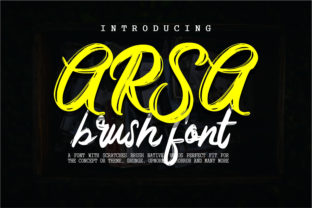
Arsa: A Bold Brush Script with Raw Energy
Imagine typing a word—and watching it leap off the screen like ink freshly flicked from a brush. That’s Arsa: a hand-drawn, high-contrast brush script that balances spontaneity with intention. It’s not polished perfection. It’s confident, slightly imperfect, and full of movement—like handwriting captured mid-thought. The “cool twist”? Subtle irregularities in stroke weight, uneven baseline alignment, and expressive terminals that give each character its own personality. It’s designed to feel human—not generated, not templated, but genuinely made.
Why Arsa Resonates Differently Across Roles
Fonts aren’t one-size-fits-all tools. What makes Arsa compelling for a food blogger might be irrelevant—or even distracting—for a university lecturer preparing lecture slides. Understanding how your role shapes your typographic needs helps you decide whether Arsa fits your workflow—or your message.
For Creatives & Designers
If you’re crafting brand identities, packaging, or social visuals, Arsa shines where authenticity matters more than uniformity. Its raw texture works beautifully on coffee bag labels, indie magazine covers, or mural mockups. You’ll appreciate how it pairs with minimalist sans-serifs (think Montserrat or Inter) for contrast, or stands alone in short headlines. Because it includes OpenType features like stylistic alternates and ligatures, you can fine-tune rhythm without switching fonts—saving time while preserving voice.
For Small Business Owners & Entrepreneurs
You’re not just choosing a font—you’re choosing a tone for your customer’s first impression. A bakery named “Hearth & Crumb” might use Arsa for its logo and menu headers to evoke warmth and craft. But if you run a B2B SaaS startup, Arsa likely won’t suit your dashboard UI or investor pitch deck—where clarity and neutrality take priority. That’s okay. Arsa isn’t meant for every touchpoint. It excels in moments where you want people to *feel* something before they read anything: signage, product tags, Instagram story text overlays, or email subject lines that stand out in a crowded inbox.
For Educators & Content Creators
Teachers building digital worksheets or educators designing workshop handouts often need fonts that engage without overwhelming. Arsa’s boldness makes headings pop—but its lower legibility at small sizes means it’s best reserved for titles, section dividers, or quote callouts—not body text. One middle school art teacher uses Arsa for student project rubric headers (“Creative Risk,” “Process Reflection”) to reinforce thematic energy without sacrificing structure. For bloggers or podcasters, it adds visual distinction to episode titles or newsletter banners—especially when paired with accessible fallbacks for screen readers and mobile rendering.
For Beginners & Hobbyists
If you’re just starting with Canva, Figma, or Google Slides, Arsa is refreshingly straightforward. No complex kerning tables to master. No licensing puzzles—it’s free for personal use and affordably licensed for commercial projects. You don’t need advanced typography knowledge to see its impact: type “Summer Sale” in Arsa, adjust size and color, and instantly sense its vibe. That immediacy lowers the barrier to making designs feel intentional—even if you’ve never adjusted tracking or baseline shift before.
What to Consider Before You Use Arsa
Not every bold font solves every problem. Here’s how practical priorities shape real-world decisions:
- Ease of use: Arsa installs like any desktop font and works natively in design apps. No web-font setup required for local projects—but if you’re embedding it on a website, you’ll need to serve it via @font-face or a service like Google Fonts (if hosted there) and test loading performance.
- Legibility: At 16px or smaller, letters like “a”, “e”, and “s” start to blur together. Reserve it for larger display sizes—headlines, posters, large-format prints—where its expressiveness has room to breathe.
- Commercial flexibility: The standard license covers logos, merchandise, and digital ads. If you’re selling templates or themes that include Arsa as a bundled asset, check the extended license terms. Most users won’t need this—but designers distributing Canva templates or Shopify themes should verify.
- Creative fit over trendiness: Arsa doesn’t chase trends. It leans into tactile imperfection—a counterpoint to ultra-sleek, AI-generated aesthetics. If your brand values craftsmanship, storytelling, or analog warmth, Arsa supports that narrative. If your goal is neutrality, scalability, or cross-platform consistency, another option may align better.
Real Examples, Not Hypotheticals
A freelance illustrator uses Arsa for client presentation slide titles—pairing it with a clean mono-spaced font for captions. The contrast signals “this is the big idea” without shouting.
A ceramicist launching an Etsy shop applies Arsa to her “Hand-Built Collection” banner image. Customers later tell her the typography made the pieces feel more personal—like they’d been signed by hand.
A nonprofit running a youth arts program chooses Arsa for event posters because teens respond to its energy. Staff noticed higher engagement on Instagram graphics using the font versus generic script alternatives.
Does Arsa Match Your Goals?
Ask yourself:
- Is this for a moment that needs to stand out emotionally, not just visually?
- Will it appear at a size where details remain clear—typically 24px and up on screen, 18pt+ in print?
- Does your project value individuality over uniformity? (Arsa won’t behave like Helvetica—it’s meant to have character.)
- Are you comfortable pairing it intentionally? Alone, it’s strong. With the wrong companion font, it can feel chaotic.
If you answered “yes” to most of those, Arsa is worth trying—not as a default, but as a deliberate choice. It won’t fix weak layout or unclear messaging. But in the right context, it adds honesty, motion, and presence. That’s rare.
And remember: typography is collaborative. Arsa doesn’t replace thoughtful hierarchy, spacing, or color—it enhances it. Try it on one headline. Print it. Step back. Does it feel like *your* voice, amplified? If yes, you’ve found more than a font. You’ve found a collaborator.