Kingfisher: Bold Vintage Charm, Layered With Purpose
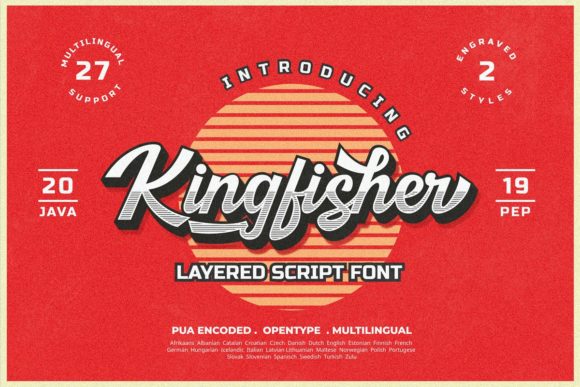
If you’ve ever paused on a vintage book cover, a hand-printed concert poster, or a craft brewery’s label and felt that quiet spark of authenticity—chances are, Kingfisher is the kind of font doing the heavy lifting. It’s not just another retro-inspired typeface. Kingfisher is a layered font with vintage style built into its DNA: strong serifs, subtle ink-trap-like contrast, and a confident, slightly weathered rhythm that feels both intentional and human-made. Think of it less as decoration and more as a quiet collaborator—one that brings warmth, character, and quiet authority to your work without shouting.
What Makes Kingfisher Feel So Distinctly *Real*
At first glance, Kingfisher reads as a bold serif—but look closer. Its layers aren’t visual effects added in post; they’re structural. The letterforms carry gentle optical adjustments: thicker downstrokes, softened terminals, and a slight tapering in curves that mimics the behavior of metal type pressed into paper. There’s no forced distress or artificial grunge. Instead, Kingfisher leans into tactility—like ink settling into fiber, or a woodcut impression holding its shape just long enough to feel deliberate. That’s why it lands so well for designers who value craft over convenience, and for brands that want heritage to feel earned, not borrowed.
It’s a premium font, yes—but not in the sense of being untouchable. It’s accessible in tone, grounded in proportion, and balanced across weights. Most versions include at least three styles: a robust Regular, a tighter Condensed (ideal for tight spaces like bottle labels or social media avatars), and often a Light or Italic variant that preserves the same structural integrity—not just a slanted version, but a considered companion. That consistency matters when building real-world design assets.
Where Kingfisher Earns Its Keep
This isn’t a font for body text in long-form web articles—or at least, not alone. Kingfisher shines brightest as a display font: commanding headlines, logo design anchors, packaging design statements, and editorial design focal points. A local bakery using Kingfisher for its chalkboard menu? It signals care, tradition, and hands-on quality. A boutique publisher setting chapter titles in Kingfisher across a limited-edition poetry collection? It adds gravitas without pretension. Even in digital spaces—think Instagram carousel headers or email campaign banners—its clarity holds up at scale, especially against muted or textured backgrounds.
It also works surprisingly well in hybrid contexts. Pair it with a clean, neutral sans serif (think Inter, Poppins, or even a well-spaced Helvetica Neue) for contrast that feels editorial, not jarring. Use Kingfisher for your brand name and the sans for supporting copy—this creates immediate visual hierarchy while keeping tone cohesive. In print, its weight and structure translate cleanly to letterpress, foil stamping, or screen printing. On screen, it renders crisply at 24px and above, making it reliable for hero sections, product cards, and CTA buttons where personality matters as much as legibility.
Readability Isn’t Just About Size—It’s About Intent
Don’t mistake Kingfisher’s boldness for brute force. Its x-height is generous, its counters are open, and spacing is tuned for breathing room—not tight compression. That means even at smaller display sizes (say, 18–20px on mobile), it remains recognizable and stable. But here’s the practical truth: avoid setting full paragraphs in Kingfisher. Not because it’s “bad,” but because its strength lies in emphasis—not endurance. Use it where you want the eye to land first, linger second, and remember third.
Audience engagement shifts subtly when you swap a generic bold sans for Kingfisher in your newsletter subject line or podcast episode title. Readers subconsciously register texture, intention, and time invested. That builds trust—not through polish, but through presence. For small business owners and content creators, that difference compounds: one thoughtful font choice can make your offer feel more considered, your voice more distinct, your brand more memorable.
Testing & Pairing: Keep It Grounded
Before committing, test Kingfisher in context—not just as a standalone specimen. Drop it into your actual layout: a mock-up of your Shopify banner, your Substack header, or your Canva social graphic. Does it hold up next to your photography? Does it compete with your logo’s weight—or complement it? Try two pairings: one minimalist (e.g., Kingfisher + a light, airy sans), and one warm-toned (e.g., Kingfisher + a soft, low-contrast serif like Lora or Merriweather). Notice how each changes the mood—not just the look.
Also check what’s included. Some Kingfisher licenses bundle OpenType features like stylistic alternates or ligatures—small touches that add nuance (e.g., a custom ampersand or swash cap) without overcomplicating. If you’re designing for print, confirm whether the version you’re evaluating includes proper hinting for PDF export and CMYK-safe outlines. And always verify commercial licensing: Kingfisher is typically a commercial font, meaning personal use is fine, but client projects, merchandise, or SaaS interfaces require an appropriate license. Reputable foundries list this clearly—don’t assume “free download” equals free-to-use.
Real Projects, Real Decisions
A wedding stationery designer used Kingfisher for suite headers paired with a delicate script for names—creating elegance without fragility. A regional coffee roaster applied it to their bag seals and tasting notes, reinforcing their “slow craft” positioning without leaning into clichéd rustic tropes. A nonfiction author chose Kingfisher for chapter openers in their paperback—giving each section a quiet, confident pause before diving into narrative. In every case, the font wasn’t chosen for trendiness. It was chosen because it aligned with values already present in the work: honesty, patience, material awareness.
That’s the quiet power of Kingfisher. It doesn’t ask you to become vintage—it helps you express what’s already true in your voice, your product, or your process. It’s not about looking old. It’s about feeling rooted.