Helostar: Modern Calligraphy with Purpose
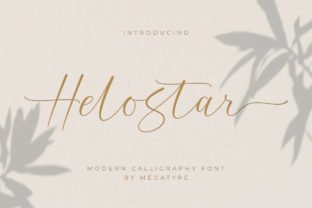
Imagine a font that doesn’t just look beautiful—but breathes life into your words. Helostar is exactly that: a modern calligraphy typeface designed with intention, not ornamentation. Its defining trait—a subtly varying baseline—gives each line organic rhythm and visual warmth, while its elegant touch avoids the stiffness of traditional script fonts or the overused flourishes of decorative alternatives. It’s not about mimicking handwriting; it’s about evoking presence, care, and clarity.
Why Baseline Variation Matters More Than You Think
Most script fonts lock letters to a rigid horizontal line. Helostar breaks that constraint thoughtfully. Letters rise and settle at slightly different vertical positions—not randomly, but with compositional awareness. This variation creates gentle movement across a line of text, guiding the eye naturally from start to finish. In practice, that means headlines feel more dynamic without sacrificing legibility, and short quotes or invitations gain quiet sophistication without needing extra design layers.
For example, a small-batch coffee roaster using Helostar for their seasonal label tagline—“Roasted in Small Batches Since 2018”—gets subtle visual texture that mirrors the handcrafted ethos. The baseline shift adds nuance where boldness or color might overwhelm. No extra graphics needed. Just thoughtful typography doing quiet, confident work.
Where Helostar Fits—and Where It Doesn’t
Helostar shines in contexts where tone and trust go hand-in-hand: brand identities for wellness studios, boutique publishers, independent educators, wedding stationers, and mindful product labels. Its elegance feels grounded, not distant—approachable without being casual. That balance makes it especially useful for professionals who want to signal quality and authenticity without leaning into clichéd “luxury” tropes.
It’s less suited for dense body copy or long-form digital reading. Helostar is a display face: best at sizes 24pt and up in print, or 32px and above on screen. Use it for headlines, logos, pull quotes, packaging front panels, social media banners, and invitation suites—not for paragraphs of blog text or interface buttons. Knowing this boundary isn’t a limitation; it’s clarity. It helps you choose wisely instead of forcing a tool where it won’t serve your audience well.
Real-Time Creative Efficiency
Many designers spend hours layering textures, adjusting letter spacing, or manually lifting individual glyphs to create visual interest. With Helostar, that lift is built in. Its baseline variation reduces the need for manual kerning tweaks in short phrases, and its open letterforms maintain readability even when scaled down modestly (e.g., 18pt on a business card). That saves time—not just in execution, but in decision fatigue.
A freelance graphic designer preparing three logo options for a new ceramic studio can rely on Helostar to deliver consistent elegance across variations—monochrome, two-color, or paired with a clean sans-serif. No need to second-guess whether the script feels “alive enough.” Helostar handles that baseline motion inherently, freeing mental space to focus on layout, hierarchy, and brand alignment.
Beyond Aesthetics: Communication That Resonates
Tone is conveyed before a single word is read. Helostar’s warmth and fluidity quietly communicate approachability, attention to detail, and human-centered values. That matters deeply for educators launching an online course, therapists building a calming website, or indie authors designing book covers. Readers don’t analyze the baseline—they feel the difference. A Helostar headline on a mindfulness workshop landing page reads as intentional and serene, not performative or overly stylized.
Contrast that with a generic script font that leans too heavily on swirls or exaggerated terminals. Those often trigger subconscious associations with outdated branding or low-effort design. Helostar avoids that trap by anchoring its elegance in structure—not decoration. Its lowercase a, g, and y have clear, functional forms. Its capitals are confident but never shouty. That restraint is what gives it longevity.
Pairing Helostar Thoughtfully
Like any strong voice, Helostar works best in conversation—not isolation. It pairs beautifully with humanist sans-serifs (think Inter, Manrope, or Work Sans) that share its warmth and openness. Avoid ultra-geometric or high-contrast serifs unless you’re aiming for deliberate tension—the goal is harmony, not contrast for contrast’s sake.
When setting Helostar alongside body text, keep line height generous (1.5–1.7x) and limit its use to one prominent element per layout. Overuse dilutes impact. A newsletter header in Helostar, followed by clean paragraph text, creates hierarchy and rhythm. Using it for both headline *and* subhead *and* CTA button? That flattens emphasis and muddies messaging.
Who Benefits Most—and Why
Small business owners launching a direct-to-consumer brand often face tight budgets and limited design support. Helostar gives them a professional-grade typographic asset that doesn’t require custom illustration or expensive licensing. Educators creating printable resources or course slides find it elevates materials without distracting from content. Bloggers and content creators using Canva or Figma appreciate that Helostar’s OpenType features (including standard ligatures and stylistic alternates) work reliably across platforms—no rendering surprises.
Importantly, Helostar isn’t for everyone—and that’s part of its strength. If your brand voice is energetic, tech-forward, or boldly minimalist, a geometric sans or monospace may align more closely. Helostar serves those who value refinement with humility: people building something meaningful, not flashy.
A Note on Licensing and Practical Use
Helostar is available under standard desktop and web font licenses. For bloggers embedding it on a personal site or freelancers using it across client projects, verify license scope—especially for SaaS platforms or embedded PDFs. Some versions include variable font axes for weight and width control, offering flexibility without loading multiple files. That’s especially helpful for responsive designs where fine-tuning at different breakpoints matters.
If you’re evaluating Helostar alongside similar options—like Brittany, Cherish, or Sofia Pro Script—look beyond first impressions. Test them in your actual context: set your core tagline, check readability at intended sizes, and assess how they behave next to your supporting typeface. Helostar’s strength lies in its consistency across weights and its restrained baseline motion—not in maximal flair.
Final Thought: Typography as Quiet Confidence
Great typography doesn’t draw attention to itself. It supports meaning, honors the reader’s time, and reflects care in execution. Helostar delivers that—not through complexity, but through considered design choices: the intelligent baseline, the balanced contrast, the absence of unnecessary embellishment. Whether you’re printing a limited-run poetry chapbook or launching a service-based business, it offers a way to say what matters—with grace, and without excess.