The Vintage Words: A Handwritten Font with Soul
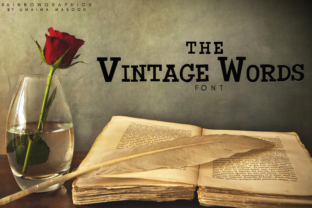
There’s something quietly powerful about a font that feels hand-drawn—not perfectly uniform, not digitally sterile, but alive with subtle variation and human rhythm. The Vintage Words is exactly that: a simple, yet unmistakably cool handwritten font with a unique charm rooted in authenticity. It doesn’t shout. It invites. And because it’s grounded in real pen-on-paper texture—slight inconsistencies in stroke weight, gentle tapering, organic spacing—it carries warmth that many “vintage” fonts lack.
What Makes The Vintage Words Stand Out
Unlike heavily distressed or overly ornate retro fonts, The Vintage Words leans into restraint. Its lowercase letters have soft curves and open counters; capitals carry just enough personality without sacrificing legibility. There are no forced flourishes or artificial grunge layers—just honest, confident handwriting translated thoughtfully into digital form. That balance makes it unusually versatile: expressive enough for storytelling, clean enough for branding, and warm enough for personal connection.
It’s also designed with practicality in mind. The character set covers standard Latin glyphs, numerals, and common punctuation—no missing accents or awkward substitutions mid-sentence. Kerning is tuned for natural flow, so words like “coffee,” “handmade,” or “gather” read smoothly, not like a string of isolated letters. That attention to detail matters when you’re building trust through typography—whether in a newsletter headline, a product label, or a classroom handout.
Creative Uses That Feel Fresh, Not Forced
Think beyond “vintage shop sign.” The Vintage Words shines where personality meets purpose—and where clarity isn’t sacrificed for style.
- Small business identity: A local bakery might use it for their chalkboard menu headers and packaging tags—paired with a neutral sans-serif (like Inter or Open Sans) for body text. The contrast feels intentional, not chaotic.
- Educational materials: Teachers and course creators use it for worksheet titles, learning objective banners, or printable reflection prompts. Its approachability lowers cognitive load—students see “you can do this” before they even read the first sentence.
- Digital storytelling: Bloggers and newsletter writers apply it sparingly—for pull quotes, section dividers, or email subject lines. One line in The Vintage Words, set at 28px with generous line height, creates pause and emphasis without overwhelming the layout.
- Printed keepsakes: Wedding invitations, recipe cards, or handmade journal covers gain quiet distinction when The Vintage Words anchors a phrase like “Made with love” or “Notes from 2024.” It signals care—not trend-chasing.
How Different Creators Adapt It Thoughtfully
Designers often test The Vintage Words as a primary display face in mood boards—then step back and ask: *Does this support the message, or distract from it?* They’ll adjust tracking (+20–+40) for tighter cohesion in logos, or reduce size and weight for subtle watermark-style credits. Consistency comes from intention, not repetition: using it only where voice matters most.
Marketers and entrepreneurs find value in its emotional resonance. A wellness brand might pair The Vintage Words with soft photography and muted tones—not to look “old,” but to signal slowness, presence, and craft. In that context, the font becomes part of the brand’s quiet confidence, not its aesthetic garnish.
Hobbyists and educators appreciate how easily it integrates into low-tech workflows. You don’t need Adobe Illustrator to use it well. Canva users apply it to social graphics with minimal adjustment. Teachers paste it into Google Docs for handouts, then export as PDFs—knowing it renders cleanly across devices. Its simplicity is its strength.
Keeping It Effective—Not Just Decorative
Typography works best when it serves the reader—not the designer’s portfolio. With The Vintage Words, effectiveness starts with restraint. Use it for short bursts: headlines, quotes, labels, callouts. Avoid full paragraphs or dense blocks of text. Its charm lives in contrast, not coverage.
Pairing matters. Try it with:
- A warm, geometric sans-serif (like Manrope or Work Sans) for modern balance;
- A light serif (like Lora or Playfair Display) for layered elegance;
- Or even clean monospaced type (like IBM Plex Mono) for unexpected, grounded contrast.
Color choice also shapes perception. Deep navy or charcoal brings out its warmth without fading. Soft terracotta or olive green adds tactile depth on print or dark-mode interfaces. Avoid oversaturated reds or neon brights—they clash with its grounded tone.
Ideas You Can Start With Today
You don’t need a big project to begin. Here are three low-lift, high-impact ways to explore The Vintage Words:
- Create a “word of the week” graphic for your Instagram or internal team channel. Use The Vintage Words for the word itself (e.g., “curious,” “pause,” “craft”), then add a short definition or question in a clean secondary font. Takes five minutes. Builds consistency and voice.
- Redesign one recurring document—a client onboarding checklist, a weekly reflection template, or a workshop agenda. Swap the default heading font for The Vintage Words. Notice how it changes the tone: less transactional, more human-centered.
- Hand-letter one sentence by tracing over a printed sample of The Vintage Words. Then scan and overlay it onto a photo or background. You’ll see firsthand how its rhythm and spacing work—and why digital replication alone doesn’t capture its full character.
That last idea reminds us: The Vintage Words isn’t about nostalgia for its own sake. It’s about borrowing the sincerity of analog tools—ink, paper, time—to bring more honesty into digital communication. Whether you’re launching a side hustle, designing a school unit, or simply choosing a font for your next blog post, it offers a quiet invitation: Let your words feel like they belong to a person—not a template.