Sweet Seventeen: A Handwritten Font with Heart
If you’ve ever scrolled past a wedding invitation, boutique packaging, or Instagram story that made you pause—not because it shouted, but because it whispered something warm and genuine—you’ve likely seen the quiet power of a well-chosen handwritten font. Sweet Seventeen is one of those rare display fonts that feels both intentional and effortless: a premium font built for moments where personality matters more than precision.
What Makes Sweet Seventeen Stand Out—Visually and Emotionally
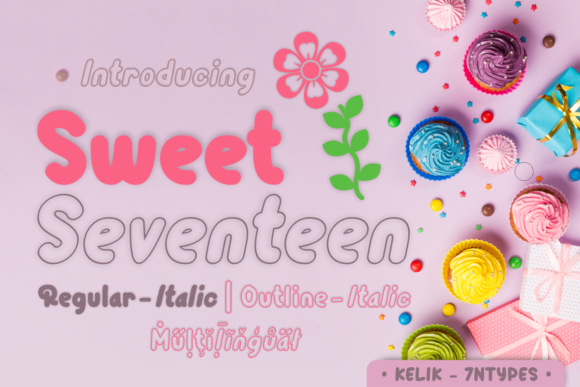
Sweet Seventeen is a contemporary handwritten font—not a looping calligraphic script, nor a rigid brush lettering style, but something in between. Its strokes carry gentle variation in weight and rhythm, with soft entry and exit tails, subtle bounce, and just enough irregularity to feel human. There’s no forced quirkiness; instead, it balances playfulness with polish. The lowercase ‘a’, ‘g’, and ‘y’ have open, friendly shapes. Uppercase letters sit comfortably upright—not slanted aggressively, not overly formal—making it legible at medium sizes without sacrificing charm.
Its personality lands somewhere between “thoughtfully crafted” and “warmly familiar.” It doesn’t try to be vintage, nor does it chase trend-driven minimalism. That’s why designers consistently reach for Sweet Seventeen when they need authenticity without cliché—whether designing a small-batch candle label, a mindful wellness blog header, or an indie book cover.
Where Sweet Seventeen Earns Its Place (and Where It Doesn’t)
This isn’t a workhorse font for body text or data tables. Sweet Seventeen is a display font—meant to lead, not support. It shines brightest where emotional resonance matters: logo design for lifestyle brands, editorial design for magazines covering food, travel, or personal growth, and packaging design for artisanal goods like chocolates, teas, or handmade soaps. On social media graphics, it adds warmth to quote cards or limited-time offers without looking dated or overdesigned.
In web design, use it sparingly—and smartly. Pair it with a clean sans serif (like Inter, Poppins, or Montserrat) for headings on landing pages or hero sections. Avoid setting full paragraphs in Sweet Seventeen, even at larger sizes; its decorative nature slows reading speed and weakens visual hierarchy. For print, it holds up beautifully on high-res stock—especially in spot-color applications where its texture can breathe.
It’s less effective in corporate reports, technical documentation, or UI interfaces where clarity and neutrality are non-negotiable. And while it works beautifully for feminine-leaning brands, it’s also been used successfully by gender-neutral skincare lines and co-ed apparel labels—proof that its appeal lies in tone, not tropes.
How It Shapes Perception—Beyond Aesthetics
Typography isn’t neutral. When you choose Sweet Seventeen, you’re signaling approachability, care, and intentionality. Audiences subconsciously associate its handwritten quality with craftsmanship and human attention—valuable traits for small businesses competing with faceless algorithms and mass-market alternatives. In brand identity systems, it helps differentiate without shouting. A bakery using Sweet Seventeen for its logo and menu headers feels more personal than one using a generic script font from a free bundle.
Consistency matters: using Sweet Seventeen only in logos but switching to a mismatched sans serif elsewhere dilutes its impact. Instead, anchor your system with it as the primary display voice—then reinforce it through thoughtful font pairing and restrained application. That builds recognition faster than adding more visual elements.
Practical Tips Before You License or Install
First, check what’s included. Most legitimate versions of Sweet Seventeen come with standard Latin characters, basic punctuation, and often ligatures or alternate glyphs (like a swash ‘Q’ or connected ‘Th’). Some include OpenType features for automatic contextual alternates—useful if you’re working in Adobe apps or modern CSS environments. Don’t assume it supports extended language sets unless verified; if you need Cyrillic or Vietnamese support, confirm before purchase.
Test readability early. Set sample text at 24px, 36px, and 48px against your intended background color. Look for crowding in tighter letter combinations (‘f’ + ‘l’, ‘r’ + ‘e’) and ensure spacing feels balanced—not cramped, not loose. If you’re embedding it on a website, test loading performance: some handwritten fonts carry large file sizes. Consider serving it as a WOFF2 with fallbacks.
Font pairing is where many designers hesitate—but it doesn’t need to be complicated. Try Sweet Seventeen with a neutral, highly legible sans serif in the same x-height range. Avoid overly geometric or condensed options; they clash tonally. A slightly warmer, humanist sans—like Lato, Nunito, or even a lighter weight of Helvetica Now—creates contrast without tension. For print layouts, consider using a simple serif (like Merriweather or PT Serif) for body copy to ground the composition.
Licensing: What Small Teams and Solo Creators Should Know
Sweet Seventeen is typically sold as a commercial font—meaning personal use (like a hobby blog or printable planner) may be covered under a basic license, but anything tied to revenue requires verification. If you’re a freelance designer licensing it for a client project, confirm whether the license permits transfer or requires the client to purchase their own. Many foundries offer multi-user or extended licenses for agencies—don’t assume one license covers your entire team.
Also note: free downloads claiming to be “Sweet Seventeen” are almost always unauthorized copies—often stripped of kerning, missing glyphs, or riddled with malware. They also risk legal exposure and inconsistent rendering. The real version is worth the investment—not just for quality, but for peace of mind and professional credibility.
Ultimately, Sweet Seventeen earns its place not by being everywhere, but by being *right*—in the right context, for the right audience, at the right moment. It won’t solve every design challenge, but when you need warmth that feels earned—not applied—it’s a tool that quietly delivers.