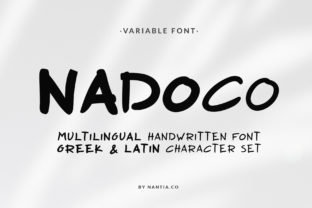
Nadoco: A Handwritten Font with Character and Clarity
Nadoco is a handwritten typeface designed to convey warmth, approachability, and individuality. It features slightly irregular letterforms, subtle stroke variation, and a relaxed rhythm—hallmarks of authentic pen-on-paper writing. Unlike script fonts that prioritize flourish or formal elegance, Nadoco balances charm with legibility, making it suitable for contexts where personality matters but readability remains essential.
Its design reflects a contemporary interpretation of casual handwriting: letters connect naturally but not obligatorily, spacing feels intentional rather than mechanical, and weight distribution avoids extreme contrast. This gives Nadoco a grounded, human quality—not overly stylized, yet distinct from generic sans-serif or serif options.
Why Consider Nadoco?
Designers and content creators often seek typefaces that reinforce tone without overwhelming message. Nadoco appeals when the goal is to signal authenticity, friendliness, or creative confidence—especially in branding, editorial design, or digital interfaces targeting audiences that value relatability over formality.
For example, independent publishers, small-batch product labels, educational platforms emphasizing learner-centered values, or wellness brands aiming for calm and sincerity may find Nadoco’s voice aligns well with their communication goals. It works effectively at medium to large sizes—headlines, banners, greeting cards, or short callouts—where its expressive qualities can be appreciated without compromising clarity.
Practical Benefits and Realistic Expectations
One strength of Nadoco is its strong visual identity with minimal setup. Because its character is consistent across weights (it typically ships as a single-weight family), pairing it with neutral supporting fonts—like a clean sans-serif for body text—is straightforward. This simplifies typographic hierarchy decisions, especially for non-specialists managing brand assets.
Legibility holds up well in print and on high-resolution screens, though it begins to soften at smaller sizes (below 16px). Readers generally recognize letters quickly, even if some characters—like lowercase a, g, or s—carry slight stylistic idiosyncrasies. These details contribute to charm but require testing in context, particularly for users with dyslexia or low vision. Nadoco is not optimized for extended reading, nor does it include extensive language support beyond basic Latin characters; users working with multilingual content should verify glyph coverage before committing.
Another consideration is licensing. Nadoco is available under standard desktop and web font licenses, but usage rights vary by vendor. Some versions permit commercial use with attribution; others require paid licenses for embedding in apps or SaaS platforms. Always review the license terms specific to the source you choose.
Where Nadoco Fits Best
Nadoco shines in applications where brevity and emotional resonance matter more than functional neutrality. Think: event invitations, podcast cover art, boutique packaging, landing page headlines, or social media graphics. Its presence signals intention—a deliberate choice to stand apart from algorithmically polished defaults.
It also performs well in collaborative environments where consistency matters but strict uniformity doesn’t. Because it avoids rigid geometry, Nadoco allows room for organic expression while still functioning as part of a cohesive system—ideal for teams balancing brand guidelines with creative flexibility.
When Alternatives May Be More Appropriate
If your project requires long-form text—such as blog posts, documentation, or reports—Nadoco is unlikely to serve as a primary body font. In those cases, pairing it with a highly legible companion (e.g., Inter, Lato, or Source Sans) is advisable, using Nadoco only for headings or accent elements.
Similarly, if accessibility compliance is a priority—particularly WCAG AA or AAA standards for contrast and text resizing—Nadoco should be used selectively. Its variable stroke width and modest x-height mean it may fall short in low-contrast scenarios or when scaled down for mobile interfaces. Testing with real users and automated tools is recommended before final implementation.
Projects requiring broad language support—including Central/Eastern European diacritics, Greek, Cyrillic, or extended punctuation—may encounter limitations. While newer releases sometimes expand character sets, many widely distributed versions of Nadoco focus narrowly on English-language use. If international reach is essential, compare alternatives like Quicksand, Nunito, or Playfair Display, which offer wider language coverage and more robust OpenType features.
Making an Informed Choice
Evaluating Nadoco isn’t about whether it’s “good” or “bad”—it’s about alignment. Start by clarifying your core need: Is the priority immediate recognition? Emotional connection? Brand differentiation? Or functional performance across devices and user groups?
If your answer leans toward expressive impact in controlled, high-visibility placements, Nadoco warrants serious consideration. Try it in mockups alongside your intended supporting typeface, and test at multiple sizes and backgrounds. Pay attention to how it behaves next to icons, photography, or interface elements—not just in isolation.
Compare it against other handwritten or semi-script options using the same criteria: Does it retain legibility at your target size? Does its rhythm complement—or compete with—your layout’s pacing? Does its tone match your audience’s expectations without feeling forced or outdated?
Also consider workflow fit. If you rely heavily on design systems or component libraries, check whether Nadoco integrates smoothly with your tooling (e.g., Figma variables, CSS custom properties, or CMS font loading strategies). Some handwritten fonts introduce rendering inconsistencies across browsers; previewing in Safari, Firefox, and Chrome helps surface potential issues early.
Finally, reflect on longevity. Trends in typography shift, but typefaces rooted in genuine handwriting tend to age more gracefully than those chasing novelty. Nadoco avoids excessive ornamentation, suggesting durability—but like any expressive font, its effectiveness depends on thoughtful application, not just aesthetic appeal.
Next Steps for Evaluation
Before adopting Nadoco, download a trial version or use a free web embed to test in your actual environment. Focus on real content—not lorem ipsum—and involve stakeholders who represent your audience. Note where it enhances meaning and where it introduces friction.
If feedback highlights inconsistency or difficulty parsing certain words, consider adjusting tracking, line height, or color contrast—or revisit whether a more neutral option better serves your primary objective. There’s no universal “best” font, only the most appropriate one for a given purpose, audience, and context.
Nadoco offers a distinct voice in a landscape full of safe choices. When matched intentionally to the right project, it adds nuance and warmth without sacrificing clarity. But like any tool with character, its value emerges not from what it is, but how—and why—it’s used.