Kronos: A Grunge-Inspired Calligraphy Font with Bold Character
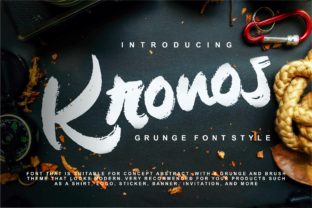
Kronos is a distinctive display typeface that merges raw, grunge-inspired texture with the expressive flow of calligraphy. It’s not a digitized script or a refined brush font—it’s intentionally imperfect: letters carry visible pressure shifts, uneven edges, and subtle ink bleeds that evoke hand-drawn urgency. Unlike many modern calligraphy fonts designed for elegance or wedding stationery, Kronos leans into contrast—thick strokes slam into fine hairlines, and characters occasionally overlap or stagger as if written in one impassioned motion. That tension is its defining trait.
What Sets Kronos Apart From Other Script and Display Fonts
Most calligraphy fonts fall into two broad categories: formal scripts (smooth, balanced, often with ligatures and swashes) and casual handwriting styles (loose, friendly, sometimes playful). Kronos occupies a narrower, more deliberate space—it’s neither polished nor whimsical. Its grunge influence shows in controlled imperfection: slight irregularities in baseline alignment, intentional roughness along stroke terminals, and a sense of weight that feels physical, almost tactile. This isn’t just “distressed” for effect; the texture supports the rhythm and energy of the letterforms.
Compared to widely used alternatives like Bruno Handwriting or Great Vibes, Kronos avoids decorative flourishes in favor of structural boldness. Where those fonts prioritize legibility at small sizes or versatility across branding contexts, Kronos excels where impact matters more than subtlety—think album art, poster headlines, editorial feature titles, or apparel graphics. It’s less suited for body text or interfaces requiring extended reading, but that’s by design, not limitation.
Fitness for Purpose: When Kronos Delivers—and When It Doesn’t
Kronos works best when the message benefits from immediacy and attitude. A music festival lineup poster gains authenticity with Kronos’ unfiltered energy; a limited-edition zine cover feels grounded by its handmade presence; a craft brewery’s seasonal release label communicates artisanal intent without leaning into rustic clichés. In each case, the font contributes tonal clarity—not just “what’s being said,” but “how it’s being said.”
That strength becomes a constraint in other settings. For example, Kronos isn’t ideal for corporate reports, academic publications, or accessibility-focused web interfaces. Its low x-height and tight spacing reduce readability at smaller sizes, and screen rendering can mute some of its textural nuance—especially on lower-resolution displays. Users evaluating Kronos for digital use should test it across devices and at multiple weights and sizes before committing.
Also worth noting: Kronos is typically offered as a single-weight display font, without built-in italics, small caps, or extensive language support beyond basic Latin characters. That makes it less flexible than system fonts or expansive families like Playfair Display or Montserrat, which offer optical sizing, variable axes, and multilingual glyphs. If your project requires typographic hierarchy across headings, subheads, and captions—or needs to serve global audiences—Kronos functions best as a focal-point accent, paired with a neutral, highly legible companion font.
Practical Pairing Strategies
Because Kronos carries strong visual personality, pairing it thoughtfully is essential. A common misstep is matching it with another high-contrast or decorative font, creating visual competition. Instead, consider contrast through simplicity: pair Kronos with a clean, no-frills sans serif (e.g., Inter, Helvetica Neue, or Public Sans) to anchor its expressiveness. The sans provides structure; Kronos supplies voice.
In print layouts, try setting Kronos at 36–60pt for headlines, then stepping down to 14–18pt for body copy in a robust text face. On websites, use CSS font-display: swap to ensure fallbacks load gracefully, and always define a fallback stack (e.g., font-family: "Kronos", "Helvetica Neue", Arial, sans-serif;). Avoid stretching or skewing Kronos artificially—its character relies on natural stroke variation, not geometric manipulation.
Real-World Use Cases and Tradeoffs
- Music branding: Kronos reinforces authenticity for indie labels or bands with gritty, analog-leaning aesthetics. Tradeoff: may feel out of place for classical, jazz, or ambient genres seeking refinement or restraint.
- Editorial features: Works well for bold magazine cover lines or section headers in culture or lifestyle publications. Tradeoff: requires generous line height and letter spacing to avoid crowding—tight tracking amplifies its density rather than enhancing readability.
- Merchandise and apparel: Prints crisply on cotton tees or tote bags when output at high resolution. Tradeoff: screen-printed versions may lose fine detail unless the design accounts for ink spread; vector outlines should be simplified for embroidery.
- Digital banners or social ads: Grabs attention quickly in feeds where users scroll rapidly. Tradeoff: legibility drops sharply below 24px on mobile—always test thumbnail-size rendering.
How Kronos Compares Across Design Contexts
Typography decisions rarely hinge on a single font—they reflect broader goals around tone, audience, medium, and longevity. Kronos stands out in environments valuing emotional resonance over neutrality. Compare it to alternatives based on functional need:
- For expressive headlines with attitude: Kronos offers more visceral texture than League Script or Parisienne, both of which lean softer and more lyrical.
- For grunge-aligned projects: It avoids the chaotic randomness of true distressed fonts (like Chiller or Grungy Typewriter) by retaining calligraphic intention—making it more versatile for professional applications.
- For brand identity systems: Kronos functions best as a primary logo or hero treatment, not as a full UI or typography system. Brands needing scalability across touchpoints will likely combine it with a modular sans or slab serif for supporting text.
Importantly, Kronos doesn’t compete with utility-first fonts. It serves a different purpose—one rooted in momentary impact, not sustained readability. That distinction helps clarify whether it belongs in your toolkit: ask not “Is Kronos good?” but “Does this project need its particular kind of boldness?”
Making an Informed Choice
If you’re evaluating Kronos alongside other options, start by auditing your actual usage—not theoretical possibilities. List every place the font will appear: website headers? App splash screens? Print posters? Packaging? Then assess each against three criteria: legibility at intended size, compatibility with surrounding type, and alignment with brand voice. Kronos scores highly on the third but demands careful handling on the first two.
Also consider licensing. Kronos is typically distributed as a commercial font—verify usage rights for web embedding, app integration, or merchandise resale before finalizing. Some vendors offer desktop-only licenses, while others include extended permissions. Misjudging this can lead to compliance issues down the line, especially for agencies or product teams managing multiple clients.
Finally, remember that typography is iterative. Try Kronos in context—not just as isolated letters on a specimen sheet, but layered over real imagery, beside actual body copy, and tested with real users. Does it elevate the message—or distract from it? Does it feel inevitable in the layout, or tacked on? Those reactions matter more than any technical spec.
Kronos won’t suit every project. But for the right context—where boldness, texture, and expressive contrast are assets, not obstacles—it delivers a rare combination: hand-crafted energy, typographic integrity, and unmistakable presence. It’s a reminder that type isn’t just about communication—it’s about character, and sometimes, the most memorable voices are the ones that refuse to blend in.