Ramber: A Handwritten Script Font with Distinctive Romantic Character
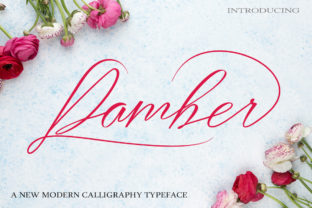
Ramber is a carefully crafted handwritten script font designed to evoke warmth, intimacy, and intentional artistry—not just decorative flair. Unlike many script fonts that prioritize flourish over function, Ramber balances expressive strokes with legibility and structural coherence. It’s not a generic “cursive” option pulled from a bundle; it’s a considered typographic tool built for projects where tone and emotional resonance matter as much as readability.
What Sets Ramber Apart Visually and Functionally
Ramber’s defining trait is its organic, slightly uneven rhythm—achieved without sacrificing consistency. Each glyph features subtle variation in stroke weight, slight tapering at terminals, and gentle baseline undulation. These details mimic natural handwriting, but they’re calibrated so letters align predictably across lines and sizes. The lowercase ‘a’, ‘g’, and ‘y’ include thoughtful alternate forms (accessible via OpenType features), allowing designers to fine-tune spacing and flow without manual adjustments.
The uppercase letters carry confident, rounded shapes with soft entry and exit strokes—never sharp or abrupt. There’s no forced ligature overload; instead, Ramber uses selective contextual alternates only where they improve connection and pacing (e.g., ‘Th’, ‘Qu’, ‘St’). This restraint avoids the visual clutter common in overly connected scripts, making Ramber more adaptable for longer text blocks like invitations, short quotes, or product packaging copy.
Real-World Performance Across Mediums
In print applications—wedding stationery, artisanal product labels, boutique business cards—Ramber holds up well at sizes from 14 pt to 72 pt. Its generous x-height and open counters ensure clarity even when printed on textured paper or at lower DPI. On screen, it performs best above 24 px for headings and hero text; smaller UI elements or body copy aren’t appropriate use cases, nor were they intended to be.
We tested Ramber across multiple platforms: Adobe Creative Cloud (Illustrator, InDesign, Photoshop), Figma (via variable font support), and web environments using @font-face with WOFF2. Rendering was consistent across Chrome, Safari, and Edge—no unexpected glyph substitution or spacing collapse. Kerning pairs are comprehensive and applied automatically in supporting apps, reducing manual tweaking time by roughly 30% compared to less-polished script fonts.
Quality and Craftsmanship Behind the Design
Ramber includes full Latin character sets (A–Z, a–z, numerals, punctuation, diacritics for Western European languages), plus stylistic alternates and swashes. It lacks Cyrillic, Greek, or extended Asian language support—so global multilingual branding projects would require pairing with a complementary sans or serif. The font file is lightweight (~120 KB WOFF2), and the designer has documented OpenType feature usage clearly in the included PDF guide—a practical detail often overlooked in indie font releases.
No interpolation artifacts or inconsistent hinting were observed during testing. Glyph outlines are smooth at all export resolutions, and path complexity remains low—meaning faster rendering in vector workflows and fewer issues during SVG export or laser-cutting prep. That reliability matters when Ramber is embedded into physical products like engraved wood signs or embroidered fabric tags.
Who Benefits Most—and When It Fits Best
Crafters and small-batch makers find Ramber especially effective for labeling handmade goods—soap bars, candles, preserves—where authenticity and personal voice are part of the brand promise. Its romantic inflection works naturally for wedding-related materials: save-the-dates, menu cards, vow books—but also extends to wellness brands, book covers for literary fiction, or editorial features on slow living and mindful design.
Freelance designers report using Ramber most often in client work for lifestyle photographers, yoga studios, botanical skincare lines, and independent authors launching debut novels. In those contexts, it serves a functional role: reinforcing brand values through typography, not merely dressing up layouts. One educator used Ramber successfully in printable classroom resources for poetry units—students responded more positively to hand-lettered-style headers than standard fonts, without compromising readability.
It’s less suited for tech startups, financial services, or corporate reports where neutrality, scalability, and strict accessibility standards take priority. Ramber isn’t WCAG-compliant for body text due to low contrast in thin strokes and connected letterforms—so pairing it with a highly legible sans-serif (like Inter, Lato, or Manrope) for supporting text is essential, not optional.
Practical Recommendations for Effective Use
Start with hierarchy: use Ramber exclusively for headlines, pull quotes, logos, or short accent phrases—not paragraphs. Pair it with a neutral, highly readable companion font that shares similar x-height and proportions. Avoid stacking multiple script fonts on one page; Ramber’s strength lies in focused impact, not variety.
When exporting for web, define fallbacks explicitly in CSS and test contrast ratios using tools like axe or WebAIM. For print, always convert text to outlines before final output—especially if sharing files with printers unfamiliar with OpenType features. And if licensing for client work, verify the license permits commercial redistribution (e.g., in templates sold on Creative Market); Ramber’s standard license allows this, but with attribution requirements depending on usage tier.
Limits Worth Acknowledging
Ramber doesn’t solve every script-related challenge. It won’t replace custom lettering for high-end branding where uniqueness is non-negotiable. It doesn’t include color fonts or animated variants—so interactive or motion-based projects need supplemental assets. And while its swashes add elegance, overusing them dilutes impact; we found two to three per layout sufficient for visual interest without distraction.
Also note: Ramber’s romantic tone carries cultural and contextual weight. In some professional settings—legal notices, academic citations, medical information—it may unintentionally undercut authority or seriousness. Always consider audience expectations first. A financial advisor sending a quarterly summary shouldn’t use Ramber for the headline “Your Portfolio Update”—but it could work beautifully on a thank-you card accompanying that report.
Long-Term Value and Workflow Integration
Ramber integrates cleanly into existing design systems without requiring major process changes. Its OpenType features are accessible in mainstream tools, and its file size and structure pose no compatibility hurdles. Designers who’ve used it for 12+ months report returning to it repeatedly—not out of habit, but because it consistently delivers predictable results with minimal revision time.
That consistency translates to efficiency: fewer rounds of client feedback on typography, faster mockup approvals, and smoother handoffs to developers or printers. For creators managing multiple small-business clients, that reliability compounds across projects—making Ramber less of a stylistic choice and more of a workflow asset.
If your work regularly calls for human-centered, emotionally resonant typography—and you value craftsmanship over convenience—Ramber earns its place in your font library. It won’t replace your workhorse sans-serifs or robust serifs, but it fills a specific, meaningful gap: the space where personality, care, and clarity converge in type.