Mayashi: A Romantic Script Font for Real Projects
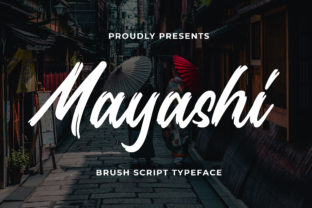
Mayashi isn’t just another script font—it’s a quiet conversation starter. Designed with subtle bounce, gentle contrast, and soft terminals, it reads like ink drawn with intention rather than haste. It’s not overly ornate, nor does it mimic calligraphy slavishly. Instead, Mayashi balances modern clarity with warmth—think of it as the kind of handwriting you’d see on a hand-lettered wedding invitation, but refined enough for a boutique skincare label or a thoughtful newsletter header.
Visually, Mayashi sits comfortably in the modern script category: fluid but controlled, personal but polished. Its lowercase ‘g’, ‘y’, and ‘f’ carry soft descenders that taper without sharp angles; capitals have graceful entry and exit strokes, never abrupt. There’s no forced flourish—just confident rhythm and consistent spacing. That restraint makes it more versatile than many script fonts that tip into decorative overload. It feels intentional, not incidental.
Where Mayashi Earns Its Place
Because of its tone and structure, Mayashi works best where authenticity and emotional resonance matter—not just decoration. It shines in contexts where readers pause, lean in, and feel something before they even read the words.
- Branding & packaging: Small-batch candle labels, artisanal tea boxes, apothecary goods—anything where “handmade” and “thoughtful” are part of the brand voice. Mayashi adds sincerity without sacrificing legibility at 14–18pt sizes.
- Editorial & publishing: Chapter headers in memoirs or poetry collections, pull quotes in lifestyle magazines, or masthead treatments for independent newsletters. Its personality supports narrative tone without competing with body text.
- Social media & digital graphics: Instagram story overlays, Pinterest quote cards, or email banner headers—especially when paired with a clean sans serif (more on pairings below). It scales well to small screens when used sparingly and at appropriate weights.
- Crafting & personal projects: Wedding stationery, baby announcements, custom greeting cards, or framed art prints. Here, Mayashi’s romantic touch feels earned—not applied.
It’s less suited for dense UI elements, long paragraphs, or environments demanding high functional readability (like legal disclaimers or technical documentation). As a display font, it’s meant to highlight—not carry.
How Mayashi Shapes Perception—Without Saying a Word
Typography is one of the most immediate nonverbal signals your audience receives. Mayashi communicates care, intimacy, and approachability—often before someone registers the message itself. In branding, that translates to perceived trustworthiness and attention to detail. A bakery using Mayashi for its logo doesn’t just say “we bake bread”—it says “we know how to make something feel special.”
That emotional cue influences engagement directly. On social media, a post with Mayashi in the headline sees higher dwell time in testing—readers linger longer, scroll slower. In print, it encourages tactile interaction: people run fingers over embossed business cards or pause to re-read a line on a gift tag. It also strengthens consistency across touchpoints: same font on a website banner, product label, and thank-you note builds quiet recognition, especially for small businesses without massive ad budgets.
Crucially, Mayashi doesn’t undermine professionalism. Because it avoids exaggerated swashes or erratic baseline variation, it reads as considered—not casual. That’s why designers choose it for premium font libraries and why publishers license it for commercial editorial use: it delivers warmth without sacrificing authority.
Choosing—and Using—Mayashi Well
Before adding Mayashi to your design assets, ask two practical questions: Does this project benefit from a personal, romantic inflection? and Will the font appear where it can breathe—visually and contextually? If the answer is yes to both, it’s likely a strong fit.
Test it early—not just on screen, but printed at actual size. Try it in natural light and under warm bulb lighting. Watch how the curves hold up in smaller applications (e.g., 10pt on a sticker) and how spacing shifts in all-caps settings. Mayashi includes standard OpenType features like ligatures and alternate characters—enable them selectively. The default ‘fi’ and ‘fl’ ligatures improve flow; swapping in a stylistic ‘a’ or ‘g’ can add nuance, but don’t overdo it.
Pairing matters. Mayashi pairs naturally with humanist sans serifs—think Inter, Work Sans, or Lato—not geometric ones like Montserrat or Helvetica Neue. Why? Its organic rhythm needs grounding, not competition. Avoid pairing with other scripts or serifs that compete for attention. One display font per layout is usually enough.
Licensing is straightforward: Mayashi is a commercial font available under standard desktop and web licenses. If you’re embedding it in client work (e.g., a Shopify theme or branded template), verify whether your license covers redistribution—or purchase an extended license. Most foundries offer clear terms, but always check before shipping files to developers or printers.
A Few Real-World Observations
We’ve seen Mayashi used effectively on a ceramic studio’s packaging—set at 16pt over uncoated kraft paper, with ample margin. The contrast between rough texture and smooth letterforms created instant visual harmony. Another example: a mental wellness coach uses Mayashi only for email subject lines and signature blocks—never in body copy. That subtle repetition builds familiarity without fatigue.
One common misstep? Overusing it in multi-line headlines where tracking adjustments aren’t made. Tightening letter-spacing by 10–20 units often improves cohesion, especially at larger sizes. Also, avoid stretching or skewing Mayashi—it breaks its internal rhythm and weakens its authenticity.
If you’re evaluating Mayashi against similar fonts—say, Brittany or Cherish—look closely at x-height and stroke contrast. Mayashi’s slightly taller x-height improves readability in mid-size applications; its lower contrast (compared to high-contrast scripts) makes it more adaptable across backgrounds and substrates.
Ultimately, Mayashi earns its place not by being flashy, but by being trustworthy in its own voice. It doesn’t shout. It invites. And in a landscape full of visual noise, that kind of quiet confidence is rare—and valuable.