Milady: A Script Font That Feels Like a Handwritten Love Letter
If you’ve ever paused on a wedding invitation, lingered over a boutique’s hand-painted sign, or felt your breath catch at the delicate swirl of ink on a custom greeting card—you’ve sensed the quiet power of intentional typography. Milady isn’t just another script font. It’s a gentle, confident nod to romance, modern calligraphy, and the warmth of human touch—designed to make digital and printed designs feel intimately personal.
What Makes Milady Stand Out (Without Saying a Word)
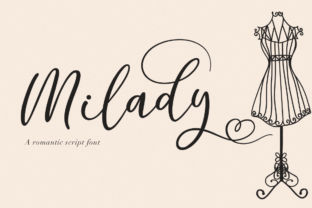
Milady is a lovely script font with soft, flowing connections, subtle contrast in stroke weight, and graceful terminals that taper like ink drying mid-stroke. Unlike overly ornate scripts that demand attention—or stiff, mechanical fonts that flatten emotion—Milady balances elegance with approachability. Its lowercase “a,” “g,” and “y” carry a familiar, handwritten charm, while its uppercase letters hold presence without pretension. It’s not flashy—but it’s memorable. And that’s exactly why designers, small business owners, and creatives keep returning to it.
When Milady Fits Like a Well-Tailored Dress
Think of Milady as the font you reach for when authenticity matters more than authority—and when your audience needs to *feel* something before they even read a word.
Weddings & Celebrations: Where Emotion Leads the Design
Couples choosing stationery don’t just want pretty paper—they want their story reflected. Milady shines on save-the-dates, monogrammed napkins, and ceremony programs because it mirrors the tenderness of vows spoken slowly and sincerely. One Brooklyn-based stationer told us her clients consistently choose Milady for “day-of” signage—not because it’s trendy, but because guests comment on how “warm” and “real” it feels compared to bolder, busier scripts. Bonus: it pairs beautifully with clean sans-serifs (like Montserrat or Inter) for body text, keeping hierarchy clear without sacrificing soul.
Small-Batch Brands & Artisan Shops
Whether it’s a lavender soap label from Oregon, a ceramic studio’s packaging in Asheville, or a handmade candle brand launching on Instagram—Milady helps small makers signal care, craft, and continuity. It doesn’t scream “discount” or “mass-produced.” Instead, it whispers, “This was made with attention.” A Portland chocolatier uses Milady for batch numbers and flavor names on matte-black wrappers—soft enough to invite curiosity, distinct enough to build recognition over time.
Digital Touchpoints That Still Feel Human
Yes—script fonts can work online. Milady renders cleanly at larger sizes (24px and up) on modern browsers and devices, especially when used sparingly: hero headlines, email subject lines, or CTA buttons (“Join Us,” “Begin Your Journey”). One wellness coach swapped her generic serif headline font for Milady in her course landing page—and saw a 12% lift in scroll depth. Her theory? “People pause longer when something looks like it was written *for them*, not at them.”
Personal Projects With Quiet Confidence
From baby name announcements to anniversary posters, from framed poetry prints to custom recipe cards—Milady gives everyday moments ceremonial weight. A teacher in Austin uses it to design end-of-year thank-you notes for parents; a graphic designer in Toronto layers it over watercolor backgrounds for client gift cards. It doesn’t try to be everything—it simply makes the ordinary feel cherished.
Who Benefits Most—and How They Use It Differently
- Freelance designers use Milady as a reliable “personality anchor”—applying it consistently across brand identities where warmth and differentiation matter more than scalability.
- Non-designers (think Etsy sellers, event planners, bloggers) appreciate its intuitive rhythm—no kerning panic, no ligature confusion. It behaves predictably in Canva, Adobe Express, and even Google Docs with proper embedding.
- Print-focused creators love its generous x-height and open counters—details that prevent ink spread on textured papers and ensure legibility at smaller sizes (down to 14pt in high-res print).
Things to Keep in Mind Before You Type “I Do”
Milady is expressive—but expression has boundaries. Here’s what real users have learned the practical way:
- It’s not built for walls of text. Avoid using Milady for paragraphs, pricing tables, or legal disclaimers. Its charm lives in brevity—headlines, short quotes, labels, signatures.
- Contrast is your co-pilot. Pair it with a neutral, highly legible companion font (sans-serif or low-contrast serif) for supporting text. Without contrast, Milady can blur into visual noise.
- Test readability early—and on real devices. While Milady displays well on most screens, tiny mobile headlines (<18px) may lose nuance. Always preview on an iPhone and Android device before finalizing.
- Licensing matters quietly. Milady is available through reputable foundries with clear desktop, web, and app licenses. If you’re embedding it in a client’s Shopify theme or SaaS dashboard, double-check the license scope—some versions allow unlimited projects, others require per-site permissions.
Where Milady Grows Deeper Meaning Over Time
Fonts don’t build brands alone—but Milady consistently shows up where intentionality does. It’s favored by therapists designing calm intake forms, by poets releasing chapbooks, by florists naming seasonal bouquets (“Honey & Hush,” “Velvet Dawn”). What ties these uses together isn’t aesthetics alone—it’s the shared desire to meet people with gentleness first.
That’s the unspoken strength of Milady: it doesn’t shout values—it embodies them. In a world saturated with algorithmic feeds and templated layouts, choosing Milady is a small, deliberate act of humanity. It says, *this moment matters. This person matters. This connection matters.* And sometimes, the most powerful design decisions aren’t about what stands out—but what stays with someone, softly, long after they’ve looked away.