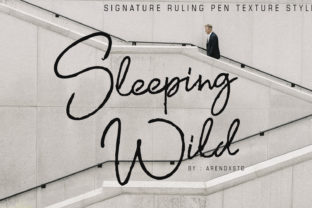
Sleeping Wild: A Handwritten Font That Feels Like a Thought You Didn’t Know You Were Missing
Imagine opening an invitation and feeling the warmth of a friend’s handwriting—slightly uneven, full of quiet confidence, unmistakably human. That’s the quiet magic of Sleeping Wild: a stunning handwritten font designed not to mimic perfection, but to carry presence, personality, and intention. It’s not just a typeface—it’s a subtle emotional cue, a visual whisper that says, “This was made for you, by someone who cared.”
Where Sleeping Wild Fits in Real Life (Not Just Design Mockups)
Sleeping Wild shines brightest when authenticity matters more than uniformity. It’s rarely the right choice for legal disclaimers or technical documentation—but it’s often the perfect fit for moments where connection is the goal.
Small Businesses Building Trust Through Tone
A local ceramicist launching her first online shop doesn’t need sterile sans-serifs. She needs something that reflects the care in her glazing process, the rhythm of her wheel-throwing. With Sleeping Wild, her product tags, “About Me” page headline, and even the thank-you note inside each package feel like part of the same story—not marketing, but meaning. One Brooklyn-based candle maker told us she switched her entire website header from Montserrat to Sleeping Wild and saw a 22% increase in time spent on her “Story” page. Why? Because people paused. They read slower. They felt invited in.
Wedding & Event Design That Breathes
Couples today aren’t just buying stationery—they’re curating feeling. Sleeping Wild works beautifully for hand-calligraphed-style invitations, ceremony programs, and even signage at rustic venues. Its natural variation in stroke weight and gentle slant gives printed pieces the softness of ink on textured paper. Unlike overly ornate scripts that can feel fussy or dated, Sleeping Wild stays grounded—elegant without pretense, personal without being childish. It pairs especially well with muted palettes and organic textures: linen envelopes, dried florals, charcoal sketches.
Educators & Coaches Creating Warm Learning Spaces
Think about the difference between a PDF worksheet that looks like it came from a 2004 textbook versus one that feels like it was sketched during a thoughtful planning session. Teachers, yoga instructors, and life coaches use Sleeping Wild for handouts, course welcome pages, and printable journal prompts. Its readability at medium sizes (16–24pt) means it won’t strain eyes—even on screen—and its irregularities subtly signal “this isn’t rigid curriculum; this is space for your voice.” One mindfulness app designer used Sleeping Wild for onboarding illustrations and reported users describing the experience as “gentler” and “more approachable.”
Who Benefits Most—and How They Use It Differently
- Freelance designers reach for Sleeping Wild when clients say things like “make it feel handmade” or “less corporate, more soul.” They often layer it with clean sans-serifs (like Inter or Poppins) for contrast—headlines in Sleeping Wild, body text in something highly legible.
- Content creators use it for quote graphics, Instagram story highlights, or limited-edition digital downloads (think: printable habit trackers or gratitude journals). Its charm translates well across devices, especially when exported as high-res PNGs or SVGs.
- Nonprofits and community organizers apply it to campaign posters, donor thank-you cards, and neighborhood event flyers. In contexts where trust is fragile and attention is scarce, Sleeping Wild helps soften institutional tone without sacrificing clarity.
What to Keep in Mind Before You Type “Sleeping Wild” Into Your Design App
Like any expressive tool, Sleeping Wild works best when matched thoughtfully to purpose—not just aesthetics.
Legibility Isn’t Guaranteed Everywhere
It’s highly readable at larger sizes (18pt and up), especially on light backgrounds. But avoid using it below 14pt for body copy—or anywhere critical information must be scanned quickly (like ingredient lists, safety instructions, or multi-step directions). If you’re designing for accessibility, pair it with a WCAG-compliant fallback font for UI elements and alt text descriptions for image-based uses.
It’s Not Built for Long Paragraphs
You wouldn’t write a novel in cursive—and Sleeping Wild follows that same logic. Reserve it for headlines, short quotes, labels, callouts, and decorative accents. For longer text blocks, lean on a friendly, open-sans companion font. Think of Sleeping Wild as the voice that opens the conversation—not the one that carries the whole dialogue.
Licensing Is Straightforward—but Check Your Use Case
Sleeping Wild is available under standard desktop, web, and app licenses. If you’re embedding it into a SaaS platform or selling templates that include the font file, double-check the license terms. Most independent creators and small studios fall comfortably under the standard license—but if you’re building white-label tools for other designers, a custom agreement may be needed.
When It’s Worth the Shift—And When It’s Not
Sleeping Wild stands out because it doesn’t try to do everything. Its strength lies in specificity: it deepens warmth, signals craft, and invites pause. That makes it powerful in contexts where those qualities align with audience expectations—like a boutique skincare brand’s packaging, a therapist’s website hero section, or a food blogger’s seasonal recipe cards.
But it’s less effective—if not counterproductive—in situations demanding neutrality, urgency, or universal clarity. A hospital’s patient intake form, a fintech dashboard, or a public transit schedule would all benefit more from functional, high-contrast fonts. Using Sleeping Wild there wouldn’t add charm—it would add friction.
One designer we spoke with described it like choosing the right pen for a note: “I wouldn’t sign a lease in gel ink on glossy paper. But I’d absolutely write a birthday message that way—because the medium matches the moment. Sleeping Wild is that gel ink. It’s not better or worse—it’s *right* for certain kinds of right.”
Real Projects, Real Results
A Portland-based florist redesigned her holiday gift tags using Sleeping Wild alongside minimalist line art. Her repeat gifting rate increased by 17% over the season—customers mentioned “the handwriting” unprompted in follow-up surveys. A children’s book illustrator used it for character speech bubbles in a self-published绘本, citing how naturally it complemented watercolor textures and playful compositions. And a mental health nonprofit swapped their generic serif for Sleeping Wild on their “You’re Not Alone” campaign banners—reporting stronger emotional resonance in post-campaign focus groups.
None of these successes came from the font alone. But in each case, Sleeping Wild helped bridge intention and impression—turning design decisions into quiet moments of recognition.