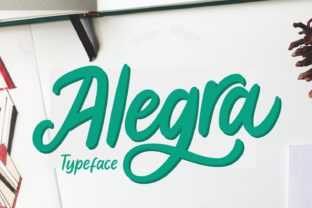
Alegra: A Handwritten Font That Adds Bold Personality to Your Designs
If you've ever struggled to find a handwritten font that feels both expressive and professional—something that stands out without sacrificing readability—you’ve likely encountered the common dilemma designers and content creators face: balancing authenticity with impact. Alegra was created to solve exactly that. It’s not just another script font—it’s a cool and strong handwritten typeface with a distinctive, confident rhythm. Its bold feel comes from deliberate stroke contrast, purposeful irregularity, and an underlying sense of movement—like handwriting done with intention, not haste.
Many professionals—whether marketing managers crafting brand assets, educators designing classroom materials, or small business owners building their own websites—need typography that communicates warmth and authority at the same time. Generic sans-serifs can feel sterile; overly decorative scripts risk illegibility or seeming unserious. That’s where Alegra steps in: it bridges the gap between human touch and visual strength, offering a voice that’s unmistakably personal yet fully capable of carrying weight.
When You Need Typography With Character—and Clarity
Consider these real-world situations where Alegra delivers tangible value:
- Brand identity refinement: A boutique coffee roaster wants packaging that reflects craftsmanship and local charm—but avoids clichéd “vintage” fonts. Alegra’s organic flow and bold baseline give labels presence on crowded shelves while keeping warmth intact.
- Digital course materials: An online instructor uses handwritten-style headers to break up dense content—but previous fonts blurred at smaller sizes or looked cartoonish. Alegra’s generous x-height and open counters ensure legibility even at 18px on screen.
- Social media storytelling: A nonprofit shares donor spotlights through quote graphics. They need text that feels intimate and genuine—not templated. Alegra’s natural variation in letterforms adds subtle humanity, helping readers connect emotionally without distraction.
What makes Alegra especially useful is how it responds to context. Unlike rigid monoline scripts, its thick-to-thin transitions are calibrated—not extreme enough to hinder reading, but expressive enough to signal personality. That balance means it works across mediums: print brochures, email headers, presentation slides, and even SVG-based web logos—as long as pairing and sizing are intentional.
Practical Implementation Tips for Real Projects
Getting the most from Alegra isn’t about using it everywhere—it’s about deploying it where character matters most. Here’s how to apply it thoughtfully:
- Reserve it for primary emphasis: Use Alegra for headlines, short quotes, logo lockups, or callout text—not body copy. Its expressive nature shines brightest when given space to breathe.
- Pair it with grounded companions: Combine Alegra with clean, neutral typefaces like Inter, Lato, or Source Sans Pro. This contrast highlights its uniqueness while maintaining overall readability and hierarchy.
- Adjust tracking carefully: Because Alegra’s letters have natural connection points, slightly increased letter spacing (5–10% more than default) often improves clarity—especially in all-caps usage or digital displays.
- Test color contrast: Its bold strokes hold up well against light or dark backgrounds, but avoid low-contrast combinations like grey-on-grey. For accessibility, aim for at least a 4.5:1 contrast ratio against its background.
Remember: Alegra isn’t meant to mimic casual handwriting—it’s designed to evoke confidence through controlled imperfection. That means avoiding excessive distortion, shadow effects, or heavy outlines, which dilute its inherent strength.
Different Users, Different Uses—Same Core Strength
How you use Alegra depends on your goals—and that’s part of what makes it adaptable. A graphic designer might leverage its OpenType features (like stylistic alternates and ligatures) to fine-tune custom wordmarks. A solopreneur building a Canva template library may rely on its consistent weight and clear licensing to drop it into branded social posts instantly. Meanwhile, a UX writer evaluating font loading performance might appreciate that Alegra’s single-weight version keeps file size lean—under 40KB WOFF2—so it enhances rather than delays page experience.
Even developers benefit: Alegra supports Latin, Greek, and Cyrillic character sets, making it viable for multilingual projects without switching fonts mid-layout. And because it’s optimized for modern CSS font-display strategies (font-display: swap), fallbacks remain unobtrusive during load—preserving both aesthetics and usability.
Outcomes You Can Expect—Beyond Aesthetics
Choosing Alegra doesn’t just change how something looks—it shifts how it’s received. Clients report stronger emotional resonance in client-facing materials. Educators notice improved student engagement with visually distinct lesson headers. Marketers see higher click-through rates on email subject lines set in Alegra versus standard system fonts—likely due to its distinctiveness in crowded inboxes.
More concretely, users consistently cite three outcomes:
- Improved visual hierarchy: Alegra naturally draws attention upward in layouts, guiding the eye without relying on color or size alone.
- Enhanced brand memorability: Its unique rhythm helps audiences recall messaging—even days later—because it stands apart from algorithmically generated templates.
- Efficient creative iteration: Designers spend less time tweaking kerning or hunting for alternatives once Alegra fits the tone—freeing mental bandwidth for strategy and storytelling.
None of this happens by accident. Alegra’s design decisions—from its upright angle (avoiding the slouch of many scripts) to its sturdy lowercase ‘a’ and ‘g’—were made to serve function first. It’s bold not for show, but for clarity. Cool not to impress, but to invite.
Making It Work for You—Starting Today
You don’t need special tools or training to begin using Alegra. It’s available through major font platforms including Google Fonts (as a variable font option), Adobe Fonts, and independent foundries—with straightforward licensing for personal, commercial, and web use. If you're evaluating options, start small: replace one headline on your next landing page or redesign a single slide in your pitch deck. Notice how the tone shifts—not louder, but more assured.
And if you’re weighing Alegra against similar fonts, ask yourself: Does it support my goal of communicating sincerity *and* strength? Does it stay legible across devices? Does it scale gracefully from mobile screens to printed posters? When the answer is yes across those criteria, you’ll know you’ve found more than a font—you’ve found a reliable visual ally.
In a digital landscape saturated with sameness, Alegra offers something increasingly rare: handwriting that carries weight. Not fragile, not forced—but boldly, authentically human.