Laracryf: A Bold Handwritten Font That Inspires
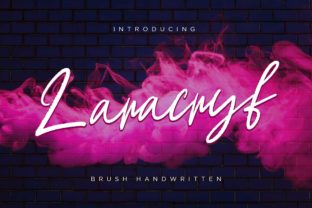
There’s something immediate and human about a well-designed handwritten font — especially one that carries weight, rhythm, and intention. Laracryf does exactly that. It’s not just another script font with flourishes tacked on. It’s a bold, confident, hand-drawn typeface built for impact — smooth in flow, grounded in structure, and expressive without sacrificing legibility.
What makes Laracryf stand out isn’t just its visual presence — it’s how it behaves across real projects. The letters have consistent stroke contrast, generous spacing, and subtle irregularities that feel intentional, not accidental. That balance between control and spontaneity is why designers reach for it when they want authenticity *and* authority — whether they’re crafting a boutique logo, designing an Instagram story, or laying out a workshop workbook.
Where Laracryf Fits Naturally
Laracryf works best where personality matters but professionalism can’t be compromised. Think of it as the go-to handwritten voice for ideas that deserve attention — not decoration. It thrives in contexts where your audience needs to feel both invited and assured: a small business owner launching a new product line, an educator creating engaging lesson materials, or a freelancer building a portfolio that reflects their craft.
Unlike overly delicate scripts or chaotic brush fonts, Laracryf holds up at smaller sizes (down to 16–18px for headings) and maintains clarity even when used in tight layouts like email headers or mobile banners. Its boldness means it rarely needs shadows, outlines, or heavy effects to stand out — which keeps your work clean, fast-loading, and accessible.
Creative Applications You Can Start Today
You don’t need a big budget or design degree to use Laracryf meaningfully. Here are practical, tested applications — each rooted in real use cases:
- Brand identity elements: Use it for taglines, subheadings, or signature phrases — never body copy. Pair it with a neutral sans-serif (like Inter, Lato, or Montserrat) to create contrast that feels intentional, not jarring.
- Social media visuals: Try it for quote graphics, limited-time offer banners, or workshop announcements. Its rhythm guides the eye naturally — perfect for quick-scrolling feeds.
- Printed collateral: It shines on postcards, event tickets, or packaging labels where tactile appeal matters. Print it on uncoated paper to enhance its hand-crafted texture.
- Educational resources: Teachers and course creators use Laracryf for section headers in PDF workbooks or slide decks — it adds warmth without distracting from content.
- Personalized digital products: Bloggers embed it in Canva templates; freelancers apply it to Notion dashboards or client onboarding kits where tone and clarity both matter.
Adapting Laracryf Across Audiences and Platforms
How you use Laracryf changes depending on who you’re speaking to — and where they’ll see it.
For small business owners, keep it focused: use Laracryf only for your brand’s core emotional hook — “Hand-poured since 2018”, “Built for makers, not managers”, or “Your first 30 minutes, on us.” Let the font carry the feeling while your supporting text delivers facts.
Marketers and content creators benefit from its versatility in A/B testing. Try Laracryf for CTA buttons (“Grab Your Spot”) versus standard sans-serif versions. You’ll often find higher engagement — not because it’s “prettier,” but because it signals approachability *and* confidence simultaneously.
Educators and coaches use it to break monotony in long-form digital content. A Laracryf heading before a reflection prompt or key takeaway helps learners pause and absorb — without needing icons or extra formatting.
On platforms like Instagram or Pinterest, Laracryf scales cleanly in square or vertical formats. Avoid stretching it — let its natural width breathe. On websites, load it as a web font via variable-weight support if possible (many modern hosts make this simple), and always define fallbacks so readability remains intact if the font fails to load.
Maintaining Clarity and Consistency
Like any expressive tool, Laracryf gains power through restraint. Overuse dilutes its impact — and risks legibility issues in longer blocks or low-contrast settings. Here’s how to keep it effective:
- Limit it to one typographic role per layout — e.g., headlines only, or quotes only. Don’t mix it with other decorative fonts.
- Respect hierarchy: If Laracryf is your H1, use a clean, highly readable sans-serif for H2s and body text. Never drop it into paragraphs or captions.
- Test color contrast: It performs best against light or mid-tone backgrounds. Avoid pairing it with busy textures or low-contrast pastels unless you’ve verified readability with tools like WebAIM’s Contrast Checker.
- Stay platform-aware: In email clients or older PDF viewers, embed it properly or convert critical text to outlines — especially for logos or legal disclaimers.
Real Projects, Real Results
A wellness coach used Laracryf for her weekly email subject lines (“You’ve got this — really.”) and saw open rates climb 12% over six weeks — not because the font “sold” more, but because readers associated it with her warm, no-jargon voice.
A local pottery studio applied Laracryf to their ceramic mugs’ hand-stamped logos — then reused the same letterforms in their website banner and Instagram highlights. Customers began recognizing the style before seeing the name — proof that consistency builds recognition faster than novelty.
A freelance UX writer chose Laracryf for the “Welcome” screen in a client’s internal training app. Team members reported the interface felt more inviting — and completion rates for onboarding modules rose 9%. The font didn’t change functionality — it changed how people *felt* about starting.
These aren’t magic outcomes. They’re the result of matching a strong visual voice to clear intent — and trusting that authenticity, when applied deliberately, resonates.
If you’ve been searching for a handwritten font that doesn’t sacrifice strength for charm — or warmth for professionalism — Laracryf offers a rare middle ground. It invites creativity without demanding perfection. It supports your message instead of competing with it. And most importantly, it works — not just in mockups, but in emails sent, signs printed, slides presented, and stories shared.
Start small: pick one recurring element in your current workflow — a newsletter header, a social bio line, a workshop title — and try Laracryf there. Notice how it shifts tone. Then decide whether to expand — or refine. That’s how meaningful design grows: not all at once, but with purpose, repetition, and attention to what actually lands.