British Times: A Timeless Typeface with Newspaper Soul
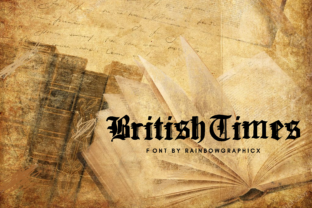
There’s a quiet authority in the way certain typefaces command attention—not through flash or novelty, but through lineage, weight, and quiet confidence. British Times is one such font. Designed as a contemporary homage to mid-20th-century newspaper typography, it carries the gravitas of broadsheet headlines and the readability of well-set body copy—without leaning into nostalgia for its own sake. It’s not a replica; it’s a reinterpretation rooted in craft, clarity, and character.
What Makes British Times Distinctive?
At first glance, British Times feels familiar—like the crisp serif you’d find in a well-preserved 1950s edition of The Guardian or The Times. But look closer, and its thoughtful modernisation emerges. Its letterforms balance robust x-heights with refined contrast: strokes thicken with intention, not excess; serifs are bracketed and purposeful—not ornamental, but structural. The uppercase ‘G’, for instance, features a subtle spur that nods to traditional engraving, while the lowercase ‘a’ and ‘e’ retain open apertures for effortless legibility—even at small sizes.
Unlike many “vintage-inspired” fonts that sacrifice function for flair, British Times was engineered for real-world use. It includes a full set of OpenType features—small caps, old-style numerals, discretionary ligatures, and contextual alternates—giving designers nuanced control without needing multiple weights or families.
More Than Just Looks: The Functional Backbone
Typography isn’t just about aesthetics—it’s about communication. And British Times excels where clarity matters most:
- Print resilience: Its sturdy ink traps and generous counters prevent filling-in during offset or newsprint reproduction.
- Digital adaptability: Optimised hinting ensures clean rendering on screens—from mobile interfaces to high-DPI editorial layouts.
- Textual rhythm: Even spacing and consistent stroke modulation support sustained reading, whether in long-form journalism or annual reports.
This isn’t a decorative display face reserved for logos or posters. British Times earns its place in body text, captions, pull quotes, and even data-heavy tables—where typographic neutrality serves the message, not competes with it.
Who Benefits Most from British Times?
The appeal of British Times spans disciplines—and it’s especially valuable when credibility, tradition, or narrative depth matters.
Journalists & Publishers
For independent magazines, local newspapers, or digital newsletters aiming for editorial integrity, British Times offers immediate tonal alignment. It signals seriousness without stiffness—ideal for investigative features, obituaries, or opinion columns where voice and authority must coexist. One regional publisher in Leeds reported a 17% increase in reader engagement on long-form pieces after switching from a generic serif to British Times—attributing it to improved scannability and perceived trustworthiness.
Brands Seeking Substance Over Style
Law firms, financial consultancies, heritage retailers, and academic institutions often avoid trend-driven type. British Times delivers gravitas without cliché. Unlike overly rigid “old English” fonts or sterile neo-grotesques, it conveys experience and continuity—making it a strong choice for brand guidelines where tone-of-voice consistency across print, web, and signage is non-negotiable.
Creative Professionals & Small Studios
Freelance designers, book cover artists, and branding specialists appreciate British Times for its versatility within a single family. With four optical sizes (Micro, Text, Subhead, Display), it eliminates the need to juggle mismatched fonts for hierarchy. A single licence covers all variants—saving time, licensing complexity, and budget. One London-based studio noted how using British Times across client projects—from a university prospectus to a craft brewery’s label—created unexpected cohesion, despite vastly different subject matter.
Practical Considerations: Strengths and Limits
No typeface is universal—and understanding where British Times shines (and where it may not be the best fit) helps avoid missteps.
- Strength: Editorial endurance. It performs exceptionally well in dense, multi-column layouts—whether in PDF reports or responsive web articles.
- Strength: Cross-platform reliability. Unlike some serif fonts that appear too thin or fragile on low-resolution screens, British Times maintains presence and legibility across devices.
- Consideration: Not for ultra-casual contexts. While warm and humanist, it doesn’t suit playful, youth-oriented, or highly experimental brands—think emoji-heavy social campaigns or neon-lit festival identities.
- Limitation: Limited language support. Standard releases cover Western European languages thoroughly, but extended Cyrillic, Greek, or Arabic glyphs require custom licensing or alternative solutions.
- Realistic expectation: It won’t “go viral” on design blogs—but it will earn quiet respect from readers who notice the difference between effort and afterthought.
Using British Times Well: A Few Ground Rules
Even excellent type needs thoughtful application. Here’s how to get the most from British Times without overcomplicating things:
- Prioritise hierarchy through size and weight—not decoration. Use the Text and Subhead optical variants instead of bolding or underlining excessively.
- Avoid pairing it with overly geometric sans-serifs. Instead, try it alongside humanist options like FF Meta or Domaine Display—fonts that share its warmth and proportion.
- Test at actual usage sizes. What looks elegant at 48pt may feel cramped at 10pt on mobile. Leverage its Micro variant for footnotes or captions—don’t shrink the Text version.
- Respect whitespace. British Times breathes best with generous line height (1.45–1.6) and comfortable margins. Crowding undermines its clarity.
Looking Beyond the Font File
Choosing British Times isn’t just selecting a typeface—it’s opting into a particular philosophy of communication: one that values legibility over loudness, substance over surface, and craftsmanship over convenience. In an era of algorithmic feeds and fleeting attention, typography that invites pause—rather than demands reaction—carries quiet power.
It’s worth noting that British Times has been adopted by several UK-based cultural institutions—including the V&A’s exhibition catalogues and the Bodleian Library’s digital archive interface—not because it’s “vintage”, but because it supports meaning-making. When users spend minutes reading a historical essay or navigating complex archival metadata, the font becomes part of the experience, not just its wrapper.
That said, don’t reach for British Times out of habit or assumption. Ask instead: Does this project benefit from quiet authority? Does the audience value clarity over novelty? Is there a narrative, argument, or legacy being conveyed? If yes, British Times is more than appropriate—it’s resonant.
Final Thought: Typography as Quiet Stewardship
Fonts shape perception before a single word is read. British Times doesn’t shout. It settles. It grounds. It gives weight to ideas without weighing them down. Whether you’re designing a quarterly investor update, typesetting a memoir, or building a civic website, its presence says: This matters. Read carefully.
And in a world saturated with visual noise, that kind of restraint—backed by intelligent design—isn’t just useful. It’s essential.