Edore: A Classy Script Font That Elevates Intentional Design
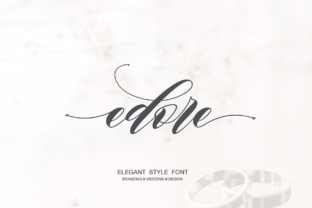
Edore is a classy script font with lovely curves—fluid, confident, and quietly expressive. It’s not merely decorative; it’s a design decision with functional weight. When chosen deliberately, Edore supports clarity of voice, strengthens emotional resonance, and reinforces brand intention—not through ornamentation alone, but through alignment between tone, audience, and outcome. For professionals who craft messages, products, or experiences—whether launching a boutique brand, designing a wedding suite, or refining a course landing page—Edore offers more than aesthetic appeal. It offers strategic nuance.
Why Edore Matters Beyond Aesthetics
Fonts are cognitive shortcuts. Readers process typeface choices in under 500 milliseconds—and that impression lingers. Edore communicates warmth, care, and refinement without shouting. Its generous letter spacing, balanced contrast, and smooth entry/exit strokes invite pause rather than skimming. That makes it especially effective when the goal isn’t speed or scale—but connection, distinction, or depth.
This matters most where attention is scarce and meaning is high: handwritten-style invitations, artisan packaging, editorial headers for lifestyle brands, signature lines in premium email campaigns, or custom illustrations paired with text. In those contexts, Edore doesn’t compete with content—it frames it. It signals that what follows has been considered, curated, and crafted—not automated or outsourced.
Where Edore Delivers Strategic Value
Edore excels where human-centered communication meets intentional positioning. Consider these grounded use cases:
- Branding for service-based businesses: A holistic wellness coach using Edore in their logo and website hero section conveys empathy and individualized care—distinct from clinical sans-serifs or overly rigid serifs. The curves suggest openness; the elegance implies professionalism without coldness.
- Educational materials with emotional resonance: An educator creating printable reflection journals for teens might use Edore for section titles and prompts. Its approachability lowers perceived barriers to engagement—making introspection feel inviting, not intimidating.
- Premium product launches: A small-batch candle brand uses Edore on labels and social banners—not for every word, but for scent names (“Amber & Rain”, “Hearth & Honey”) and limited-edition tags. The font becomes part of the unboxing rhythm, reinforcing scarcity and craftsmanship.
- Personalized client deliverables: Freelancers sending branded proposals or strategy decks can apply Edore to cover titles and key headings. It subtly differentiates their work from templated competitors—suggesting time, taste, and tailored effort.
Notice what’s consistent: Edore is rarely used at scale or in isolation. It serves as an accent—not the foundation. Its power lies in contrast: pairing it with a clean, highly legible sans-serif (like Inter, Lato, or Manrope) for body copy creates visual hierarchy and ensures readability without sacrificing personality.
When Not to Use Edore—And Why It Matters
Edore is not a universal solution. Using it without context risks misalignment—or worse, unintended messaging. Avoid Edore when:
- Clarity trumps character: Legal disclaimers, technical documentation, accessibility-critical interfaces, or multilingual signage demand maximum legibility. Edore’s connected strokes and variable stroke width reduce scanning efficiency in dense or functional text.
- Your audience values utility over elegance: B2B SaaS dashboards, industrial equipment manuals, or public transit apps prioritize speed and precision. Edore’s romantic tone may unintentionally signal informality or lack of rigor.
- You’re optimizing for fast-loading digital assets: As a variable-weight script font, Edore may require careful subsetting or fallback strategies. If performance metrics (e.g., Core Web Vitals) are critical, test render times before full rollout.
- Brand voice is intentionally bold, minimalist, or disruptive: A fintech startup building trust through transparency may find Edore too soft. Its curves soften edges—valuable in some contexts, diluting in others.
The risk isn’t that Edore looks “bad.” It’s that it sends a quiet, persistent message that doesn’t match your goals. That mismatch accumulates—eroding credibility, confusing positioning, or slowing conversion—especially over repeated touchpoints.
Using Edore With Purpose: A Practical Framework
Intentional use starts with asking three questions before applying Edore:
- What emotion or impression do I want this element to carry? (e.g., “I want the ‘About’ page headline to feel personal and grounded—not corporate or distant.”)
- Who will see this—and what do they need from it right now? (e.g., “A bride reviewing invitation proofs needs confidence, not confusion—so Edore works only on the couple’s names, not RSVP instructions.”)
- Does this usage support—not distract from—the next action I want them to take? (e.g., “Using Edore on the ‘Book Now’ button would reduce scannability. But using it on the testimonial quote above it? That builds trust first.”)
Apply Edore in layers—not all at once. Start with one high-impact location: a logo lockup, a hero section title, or a signature line. Measure response: Does engagement increase? Do users describe the brand differently in feedback? Does it improve perceived quality in user testing? Let real-world outcomes—not just preference—guide expansion.
Practical Tips for Implementation
- Licensing matters: Edore is commercially licensed. Verify usage rights for web, print, and app embedding—especially if distributing templates or white-labeled tools. Unauthorized use carries legal and reputational risk.
- Pair thoughtfully: Never pair Edore with another script font. Choose a neutral, well-hinted sans-serif for contrast and readability. Test at 16px and 24px on mobile—curves should remain distinct, not blur together.
- Limit scope: Reserve Edore for no more than 10–15% of visible text per layout. Overuse flattens its impact and strains reading flow.
- Consider cultural resonance: While universally legible, script fonts like Edore carry subtle Western calligraphic associations. If serving global audiences, test with native readers—especially where formal scripts hold specific ceremonial or historical weight.
Long-Term Thinking: Edore as Part of Your Visual Language System
Fonts gain meaning over time—not in isolation, but through repetition and context. Edore becomes more powerful the more consistently and appropriately it’s applied across touchpoints: a newsletter header, a printed workshop handout, the “thank you” screen after checkout. That consistency builds recognition—not just of the font, but of the values it represents: care, intention, human scale.
That said, don’t treat Edore as permanent. Revisit its role annually. Has your audience shifted? Have your goals evolved from “building awareness” to “driving repeat purchases”? Does Edore still serve—or has it become habitual rather than strategic? The most effective designers and brand builders audit their typography—not just their analytics.
Edore remains valuable precisely because it’s selective. It asks you to slow down, choose carefully, and align form with function. In a world of AI-generated templates and algorithm-driven design, that discipline is rare—and increasingly valuable. It’s not about making things look “prettier.” It’s about making them feel more true.