Alenor: A Sweet & Romantic Crafting Font
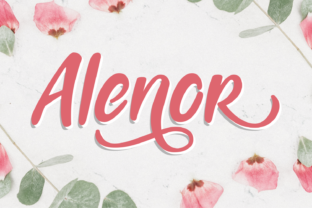
Alenor is a hand-crafted script font with gentle curves, soft terminals, and a delicate rhythm that evokes handwritten love letters, vintage wedding stationery, or artisanal bakery labels. It’s not a flashy display face—it’s warm, approachable, and quietly expressive. Each glyph flows like ink dipped just right: slightly uneven, intentionally organic, never mechanical. That’s what makes Alenor more than decoration—it’s a tone-setter.
Why Alenor Resonates Across Different Goals
What feels like “just a pretty font” to one person might be the missing ingredient in someone else’s project—because typography isn’t neutral. It carries weight, mood, and unspoken context. Alenor’s romantic sweetness matters differently depending on who’s using it and why.
For Beginners Exploring Design
If you’re new to digital design tools—whether Canva, Google Slides, or even Word—you’ll appreciate how Alenor adds polish without complexity. Its clear letterforms avoid the tangled loops of some scripts, making it readable at small sizes (think thank-you card body text or social media captions). You don’t need kerning expertise to get good results: spacing is thoughtfully built-in, and common ligatures (like “fi” or “fl”) are included as standard. Try pairing it with a clean sans-serif like Lato or Inter for contrast—no theory required.
For Educators and Content Creators
Teachers crafting classroom posters, homeschoolers designing printable storybooks, or podcasters building brand assets often seek fonts that feel human—not corporate. Alenor brings warmth to learning materials without sacrificing clarity. One third-grade teacher used it for weekly “Kindness Notes,” laminated and handed out to students; another educator embedded it into editable PDF worksheets for early writers, finding its flowing style encouraged cursive practice more naturally than rigid models. For creators building a consistent visual voice—especially around themes like mindfulness, self-care, or storytelling—Alenor signals intentionality, not just aesthetics.
For Small Business Owners and Makers
If you sell handmade candles, custom stationery, or small-batch preserves, your packaging and web presence need to reflect craft, care, and personality. Alenor supports that. It’s subtle enough for professional use—unlike overly ornate scripts that distract from product photography—but distinctive enough to stand out in a crowded Etsy shop or Instagram feed. A ceramicist uses Alenor for her “Made With Love” stamp imprint; a florist applies it to digital order confirmations to soften transactional language. Importantly, Alenor includes OpenType features like stylistic alternates and swashes—so you can add flair where it enhances meaning (e.g., a looping “&” in a business name), not just decoration.
For Freelancers and Design Professionals
Experienced designers evaluate Alenor through layers: character set completeness (it supports Latin-based Western European languages), hinting quality (it renders cleanly on screens and print), and licensing flexibility. Unlike free script fonts that lack diacritics or bold weights, Alenor ships with full punctuation, numerals, and multilingual support—including accented characters used in French, Spanish, and Portuguese. That means fewer last-minute substitutions when a client requests bilingual packaging or a wedding suite with names like “José” or “Chloé.” Its light weight works beautifully for elegant headers; its regular weight holds up in mid-size body copy. And because it’s designed as a single-family font—not part of a sprawling superfamily—it avoids visual inconsistency across projects.
For Hobbyists and Personal Projects
Sometimes, the most meaningful use of a font is quiet and private: a birthday banner for a child’s room, a framed quote for a friend’s baby shower, or journal headers that make daily reflection feel special. Alenor excels here—not because it’s technically advanced, but because it feels *kind*. Its lowercase “a,” “g,” and “y” have open, friendly shapes; its capitals rise gently rather than assertively. One hobbyist shared how she used Alenor to transcribe her grandmother’s handwritten recipes into a printed keepsake book—“It didn’t try to replace her handwriting,” she said, “but honored its spirit.”
What to Consider Before Choosing Alenor
Alenor shines brightest when your goal aligns with its strengths—and knowing those helps avoid mismatched expectations.
- Ease of use: Very high. No steep learning curve. Works well in beginner-friendly apps and professional software alike.
- Flexibility: Moderate. It’s not meant for data tables, technical documentation, or UI interfaces—but it’s versatile within expressive, human-centered contexts.
- Presentation value: High. Especially for print, branding, and emotionally resonant digital content.
- Creative spark: Strong. Its rhythm invites thoughtful composition—pairing it with texture, color, or whitespace becomes intuitive.
- Commercial scope: Clear licensing allows use in client work, merchandise, and digital products—just verify the license tier matches your usage (e.g., desktop vs. webfont).
It’s less ideal if you need extreme legibility at tiny sizes (like app buttons), heavy typographic hierarchy (it has no bold or condensed variants), or ultra-modern minimalism. That’s not a limitation—it’s focus.
Real-World Uses That Fit Naturally
- A freelance copywriter designing a lead magnet titled “5 Gentle Ways to Start Your Morning”—using Alenor for the title and subheads to reinforce calm, nurturing energy.
- A university librarian creating a “Storytime Spotlight” poster for preschoolers—choosing Alenor to signal warmth and invitation, not authority.
- A wedding planner embedding Alenor into editable Canva templates for couples to customize their own invitations—knowing it scales well and feels personal without requiring design skills.
- A blogger documenting her zero-waste journey adding Alenor to recipe cards and seasonal reflection prompts—creating visual continuity across years of content.
None of these require mastery—just attention to purpose. Alenor doesn’t shout. It leans in. That’s why it endures: not as a trend, but as a tool for people who want their words to land with sincerity.
Does Alenor Match Your Next Project?
Ask yourself:
- Is emotional resonance more important than stark efficiency?
- Do you want your text to feel handmade—even if it’s digital?
- Are you communicating care, celebration, intimacy, or creativity?
- Will readers spend time with this text—not just scan it?
If yes to two or more, Alenor is worth testing. Download a trial, type a sentence that matters to you, and sit with it for a minute. Does it feel like *you*—or the version of you your audience needs to see? That quiet alignment is where great typography begins.