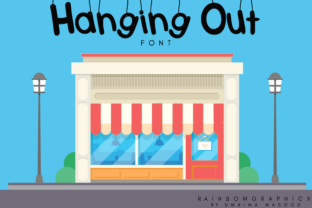
Hanging Out: A Playful, Expressive Font for Creative Projects
Imagine a font that doesn’t just say something—but grins while saying it. Hanging out is exactly that: a decorative typeface bursting with personality, charm, and intentional whimsy. Designed to evoke lightheartedness and spontaneity, it’s not your typical headline or body font. Instead, Hanging out thrives where tone matters as much as text—on posters, social posts, packaging, invitations, and digital banners where fun isn’t optional—it’s the point.
What Makes Hanging Out Stand Out (and Sway)
At first glance, Hanging out feels familiar—like handwriting you’d see scrawled on a café chalkboard or doodled in the margin of a notebook. But look closer: its letters have subtle quirks. Some characters tilt playfully; others stretch or compress like they’re leaning into a joke. The “g” loops lazily, the “a” opens wide and friendly, and the lowercase “y” dangles with cheerful abandon—hence the name Hanging out.
This isn’t randomness—it’s thoughtful design. Each glyph balances legibility with expressive flair. It avoids the pitfalls of overly chaotic display fonts by maintaining consistent spacing, rhythm, and weight contrast. That means it reads well at medium sizes (36–96px), especially against clean backgrounds, without sacrificing its signature charm.
Key Characteristics You’ll Notice Right Away
- Loose, organic spacing—creates breathing room and visual ease
- Asymmetrical balance—letters lean, curve, and vary just enough to feel alive
- Warm, rounded terminals—soft edges invite approachability, not aloofness
- Single-weight design—focused on impact over versatility, making it purpose-built for emphasis
Where Hanging Out Shines (and Where It Doesn’t)
Hanging out excels in contexts where voice and vibe are central. Think of it as the font equivalent of a well-timed laugh in conversation—it lands best when used intentionally, sparingly, and with confidence.
Great Fits for Hanging Out
- Event branding—music festivals, pop-up markets, or community workshops benefit from its upbeat, inclusive energy
- Social media graphics—Instagram Stories, TikTok thumbnails, or Pinterest pins gain instant warmth and memorability
- Product packaging for lifestyle brands—think artisanal snacks, indie beauty lines, or eco-friendly apparel labels aiming for friendly authenticity
- Invitations and greeting cards—birthdays, baby showers, or “just because” notes feel more personal and joyful
- Website hero sections or call-to-action buttons—when paired with a neutral sans-serif for body text, it creates compelling visual hierarchy
Conversely, Hanging out isn’t built for dense paragraphs, legal disclaimers, data tables, or interfaces requiring rapid scanning. Its decorative nature reduces readability below ~24px, especially in long-form settings. That’s not a flaw—it’s a feature. Like choosing a bold scarf over a turtleneck, you wear Hanging out to make a statement, not to blend in.
Who Benefits Most From Using Hanging Out?
While anyone can enjoy Hanging out, it resonates most strongly with creators and teams who value emotional resonance alongside aesthetics:
- Small business owners launching a new product line or rebranding with a focus on connection and authenticity
- Graphic designers building brand identities for clients in wellness, education, food, or creative services
- Social media managers looking to differentiate their feed with cohesive, human-scaled visuals
- Teachers and educators designing classroom posters or student handouts that feel welcoming and low-pressure
- Content creators producing YouTube thumbnails, podcast cover art, or newsletter headers that reflect playful expertise
It’s also a favorite among non-designers—bloggers, makers, and local organizers—who want professional-looking visuals without needing advanced typography knowledge. Because Hanging out communicates so clearly on its own, it lowers the barrier to creating emotionally intelligent design.
Real-World Uses That Prove Its Versatility
Consider these actual applications—each leveraging Hanging out’s strengths without overextending them:
- A Brooklyn-based yoga studio uses Hanging out for their monthly “Sip & Stretch” event poster—paired with soft lavender tones and minimalist line art. Attendees consistently comment on how “inviting” and “unintimidating” the messaging feels.
- An indie board game publisher features Hanging out on the box cover for a cooperative storytelling game called *Cloud Catchers*. The font’s buoyant rhythm mirrors the game’s light, imaginative tone—and helps it stand out on crowded retail shelves.
- A children’s literacy nonprofit uses Hanging out in digital reading challenge badges (“You’re Hanging Out With 5 New Words!”). Teachers report higher engagement because the font feels celebratory—not corrective.
Practical Tips for Getting the Most From Hanging Out
Using Hanging out effectively is less about rules and more about rhythm and restraint. Here’s what experienced users recommend:
- Pair it wisely: Contrast is key. Match Hanging out with a crisp, neutral sans-serif (like Inter, Open Sans, or Montserrat) for supporting text. Avoid other decorative fonts—they’ll compete, not complement.
- Limit usage to one focal element per layout: A headline, a button label, or a short quote—never body copy, captions, or navigation menus.
- Test color contrast carefully: Its rounded forms soften edges, so ensure sufficient contrast against backgrounds—especially for accessibility compliance (aim for at least 4.5:1 against white or light neutrals).
- Embrace its imperfection: Don’t force perfect alignment or uniform sizing. Let it breathe. Sometimes a slightly off-center “Hanging out” treatment feels more human—and more memorable.
- Check licensing early: While many versions are available for personal use, commercial projects often require a standard desktop or web license—always verify before finalizing designs.
Thinking Beyond the Font: What Hanging Out Represents
In a digital landscape saturated with sleek minimalism and algorithm-optimized sameness, Hanging out quietly champions something different: delight as design strategy. It reminds us that typography isn’t just about communication—it’s about connection. When a viewer pauses, smiles, and feels seen by a single word set in Hanging out, that’s not accidental. It’s intention made visible.
That said, it’s not a universal solution. Its value lies in specificity—not scale. If your goal is clarity above all, go neutral. If your aim is warmth, wit, and gentle irreverence, Hanging out may be the missing ingredient you didn’t know your project needed.
Is Hanging Out Right for Your Next Project?
Ask yourself three simple questions:
- Does this piece need to feel human first, polished second?
- Will the message land stronger with a dose of lighthearted confidence?
- Can I commit to using it thoughtfully—not everywhere, but exactly where it counts?
If you answered “yes” to two or more, Hanging out is worth exploring. Download a trial version, test it in context, and observe how it shifts the mood—not just of your layout, but of how people respond to it.
After all, great typography doesn’t shout. Sometimes, it just leans in, winks, and says, “Hey—want to hang out?”