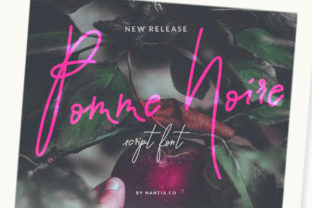
Pomme Noir: A Light Script Font for Handcrafted Design
Imagine opening a beautifully designed invitation, scrolling through a boutique’s Instagram story, or reading a thoughtful blog post—and instantly sensing warmth, intention, and care. That subtle emotional resonance often starts with typography. Pomme Noir is a light script font crafted to deliver exactly that: an authentic, hand-drawn sensibility without sacrificing clarity or versatility. It’s not just decorative—it’s purpose-built for designers and creators who value nuance over noise.
What Makes Pomme Noir Distinctive
Pomme Noir stands apart from many script fonts because it balances delicacy with legibility. Its strokes are fine but consistent, its connections intentional rather than automatic, and its rhythm relaxed—not hurried or overly formal. Unlike dense, high-contrast scripts that can overwhelm small sizes or tight layouts, Pomme Noir’s open counters and gentle baseline variation allow it to breathe on screen and in print. It feels like ink drawn with a flexible nib, yet it renders cleanly even at 14px on a retina display.
This isn’t a “one-trick” font. Pomme Noir includes standard ligatures, discretionary swashes, and alternate characters—enough to add personality without requiring deep OpenType expertise. You don’t need to be a typographic specialist to use it well; you just need to understand when subtlety serves your message better than boldness.
Strengthening Brand Voice Without Overcomplicating
Small business owners launching a new artisanal product line—or educators building a calming online course—often struggle to convey sincerity without sounding generic. Pomme Noir helps anchor tone. A wellness coach using Pomme Noir for email headers and quote graphics communicates approachability and mindfulness more effectively than a rigid sans-serif could. It doesn’t shout; it invites. And because it pairs naturally with clean, neutral typefaces (like Inter, Lora, or even Roboto), it integrates smoothly into existing brand systems—no full redesign required.
Saving Time on Visual Storytelling
Freelancers and marketers frequently juggle tight deadlines across social media, email campaigns, and client presentations. Pomme Noir reduces decision fatigue. Instead of hunting for the “perfect” handwritten asset for every banner or testimonial graphic, you can rely on one versatile script font that adapts across contexts. Use it lightly for subheadings in Canva templates, set pull quotes in Notion docs, or layer it over muted photography for Instagram carousels—all with consistent visual language. That consistency builds recognition faster than switching between multiple handwriting-style assets.
Supporting Creativity Through Restraint
Hobbyists and bloggers sometimes over-design, adding flourishes that distract from their core message. Pomme Noir encourages restraint by offering elegance without excess. Its light weight means it doesn’t dominate—it complements. Try setting a short recipe title in Pomme Noir over a soft food photo, then follow with body text in a readable serif. The contrast feels intentional, not forced. That kind of thoughtful hierarchy emerges naturally, freeing mental space for content instead of decoration.
Who Benefits Most—and Why
Professionals who regularly communicate warmth, craftsmanship, or personal insight tend to get the most out of Pomme Noir. Think: independent publishers releasing poetry chapbooks, wedding stationery designers balancing romance and readability, or educators creating printable reflection worksheets for students. These users aren’t chasing trends—they’re solving real problems: how to make digital interactions feel human, how to signal quality without luxury pricing, how to stand out in crowded feeds without shouting.
It’s also especially useful for those working across platforms where rendering control is limited. Pomme Noir’s clean vector outlines and modest x-height mean it performs reliably in Figma, Adobe Express, Google Slides, and even some CMS editors—unlike ultra-thin or highly connected scripts that risk collapsing or blurring on mobile.
Practical Tips for Getting Started
- Start small: Apply Pomme Noir only to one element per layout—like a headline, signature line, or chapter opener—to test how it lands with your audience.
- Pair thoughtfully: Combine it with a low-contrast serif (e.g., Cormorant Garamond) for editorial projects, or a friendly geometric sans (e.g., Manrope) for modern brand work. Avoid pairing with other scripts—it competes, not complements.
- Adjust tracking deliberately: Because Pomme Noir is light, slightly increased letter spacing (5–10 units in design apps) often improves readability, especially at smaller sizes or on busy backgrounds.
- Test contrast early: On light backgrounds, use black or near-black for Pomme Noir. Avoid gray or pastel fills unless you’ve verified legibility at actual viewing distance.
When to Consider Alternatives
Pomme Noir excels in contexts where subtlety and craft matter—but it’s not universal. If your project demands high impact at distance (like event signage or app buttons), a bolder script or display font may serve better. Similarly, if you need extensive language support beyond Latin-based scripts (e.g., Cyrillic or Vietnamese diacritics), verify coverage before committing—Pomme Noir’s character set prioritizes English, French, Spanish, and German use cases.
Also keep in mind: Pomme Noir is a script font, so extended body text remains impractical. Reserve it for titles, accents, and short phrases—not paragraphs. That limitation isn’t a flaw—it’s a feature. It reminds you to prioritize function: choose the right tool for the job, not the flashiest one.
A Thoughtful Choice, Not Just Another Font
In a landscape saturated with “handwritten” fonts that mimic chalk, brush, or marker—often at the cost of cohesion—Pomme Noir offers something quieter but more enduring. It reflects care in its construction and rewards care in its use. You won’t find it dominating trending design galleries, but you’ll notice it in the details of work that lingers: a thank-you note that feels personal, a product label that suggests integrity, a presentation slide where the typography supports—not overshadows—the idea.
That’s the quiet power of Pomme Noir: it doesn’t ask to be seen first. It asks to be felt—gently, authentically, and consistently. Whether you're refining a logo lockup, designing a workshop workbook, or selecting fonts for your next newsletter, Pomme Noir gives you a reliable way to signal thoughtfulness without saying a word.
And in today’s fast-moving creative environment, that kind of quiet confidence—backed by solid typographic fundamentals—is increasingly rare. And increasingly valuable.