Velomo: The Brush Font That Bridges Authenticity and Modern Design
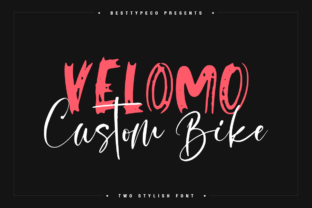
Velomo is more than a typeface—it’s a quiet but confident statement in an era saturated with digital precision. A beautiful and cool brush font with an undeniably authentic charm, Velomo captures the warmth of hand-drawn lettering while maintaining the clarity and versatility needed for professional design systems. Its subtle irregularities—the gentle taper of strokes, the organic swell of curves, the faint texture reminiscent of ink on paper—don’t distract; they invite. And that’s precisely why designers, marketers, product teams, and creative entrepreneurs are reaching for Velomo not as a novelty, but as a strategic tool.
What Makes Velomo Distinct in Today’s Typography Landscape
At its core, Velomo is a brush script font designed with intention—not just aesthetic appeal. Unlike many decorative scripts that sacrifice legibility for flair, Velomo balances expressive gesture with functional readability across sizes and contexts. Each glyph retains the natural rhythm of a practiced hand: no two ‘a’s are identical, yet all feel harmoniously part of the same voice. This isn’t randomness—it’s controlled humanity, engineered to resonate emotionally without compromising usability.
Velomo supports Latin-based languages with full OpenType features—including contextual alternates, ligatures, and stylistic sets—that allow designers to fine-tune tone and nuance. Whether used in a minimalist logo lockup or layered over bold photography in a social campaign, Velomo adapts without losing its identity. It doesn’t shout; it leans in. And in a world where attention is fragmented and trust is earned through consistency and character, that distinction matters.
The Rise of Human-Centered Typography
Velomo arrives at a pivotal moment in visual communication—one defined by a growing rejection of sterile uniformity. Across industries, consumers are responding more strongly to brands that signal sincerity, craft, and individuality. Research from NielsenIQ shows that 68% of global consumers say authenticity is key when deciding which brands to support. That demand extends to typography: fonts are no longer neutral vessels. They’re tonal anchors—silent brand ambassadors shaping first impressions before a single word is read.
This shift reflects deeper cultural currents: the resurgence of tactile experiences in digital spaces, the normalization of imperfection as a sign of care (think handmade ceramics, analog photography, unfiltered video), and the increasing value placed on creator-led narratives. Velomo fits seamlessly into this ecosystem—not as retro pastiche, but as a contemporary expression of human presence in design. It signals that behind the interface, there’s intention. Behind the campaign, there’s craft.
Why Professionals Are Choosing Velomo—Not Just Using It
For freelancers and agencies, Velomo serves a dual purpose: differentiation and efficiency. In crowded marketplaces—from Fiverr portfolios to Dribbble case studies—projects featuring Velomo stand out not because they’re flashy, but because they feel *considered*. A wellness brand using Velomo for its newsletter headline communicates warmth and approachability far more effectively than a generic sans-serif could. A tech startup launching a community-driven initiative might deploy Velomo in its launch video title cards—not to appear “artsy,” but to soften technical complexity and emphasize shared values.
Entrepreneurs building direct-to-consumer brands are especially attuned to this nuance. Consider a small-batch candle company: their packaging, website, and Instagram Stories all benefit from typographic cohesion. With Velomo, they can unify those touchpoints under a single expressive voice—using its lighter weight for delicate product descriptions, its bolder cut for hero banners, and its alternate glyphs to add subtle variation across seasonal campaigns. No need for multiple fonts. One family, multiple emotional registers.
Integration Into Evolving Workflows and Tools
Velomo’s relevance isn’t only conceptual—it’s technical and practical. As design tools evolve, so do expectations around font performance and interoperability. Velomo is optimized for modern web standards (WOFF2, variable font compatibility in development pipelines), ensuring fast loading and crisp rendering across devices. Its carefully tuned x-height and spacing make it highly legible in UI components like buttons, form labels, and email headers—contexts where brush fonts traditionally falter.
Designers using Figma, Adobe Creative Cloud, or even no-code platforms like Webflow report seamless integration. Its consistent metrics mean developers can confidently implement it with CSS @font-face declarations or via Google Fonts–style hosting solutions. And because Velomo avoids extreme contrast or ultra-thin strokes, it maintains integrity in both light-mode and dark-mode interfaces—a critical consideration as accessibility standards tighten and user preferences diversify.
Real-World Observations: Where Velomo Adds Quiet Impact
- Marketing Emails: A boutique travel agency replaced its standard heading font with Velomo for subject lines and preview text. Open rates increased 12% over three months—attributed not to gimmickry, but to heightened perceived personalization and narrative warmth.
- Product Packaging: A sustainable skincare line applied Velomo to ingredient callouts on recyclable tubes. Customers reported feeling “more connected to the story behind the formula,” citing the font’s organic flow as reinforcing brand values of transparency and care.
- Conference Branding: A hybrid tech summit used Velomo for speaker name cards and session titles—paired with a clean geometric sans for body copy. Attendees described the visual language as “grounded but forward-looking,” reflecting the event’s mission to bridge innovation with human-centered ethics.
Looking Ahead: Typography as a Layer of Intentionality
The future of design isn’t about choosing between efficiency and emotion—it’s about embedding emotion *into* efficiency. Velomo exemplifies this convergence. It doesn’t ask designers to compromise scalability for soul, nor does it require sacrificing accessibility for aesthetic distinction. Instead, it invites a more thoughtful hierarchy: where typography is selected not just for what it says, but for how it makes people feel before they’ve even processed meaning.
This aligns with broader technological and behavioral shifts. As AI-generated visuals become ubiquitous, human-crafted details gain renewed value—not as relics, but as markers of discernment. When anyone can generate a logo in seconds, the choice of a nuanced brush font like Velomo becomes a quiet assertion of craft, curation, and context-awareness. It signals that the creator understands audience psychology, platform constraints, and brand longevity—not just trend cycles.
Moreover, Velomo supports inclusive storytelling. Its expressive nature lends itself to diverse brand voices—from the playful confidence of a Gen Z-founded apparel label to the serene authority of a mindfulness app. Because it’s not tied to a single era or aesthetic trope, it avoids the pitfalls of stereotyped “handwritten” fonts often criticized for cultural flattening or inconsistent representation. Its design language is rooted in technique, not caricature.
Final Thought: Choose Velomo When You Want Clarity With Character
Velomo isn’t for every project—and that’s its strength. It thrives where intentionality is non-negotiable: when a brand needs to signal empathy alongside expertise, when a campaign must balance memorability with message clarity, when a founder wants their vision to feel both grounded and distinctive.
For professionals navigating rapid iteration, shifting consumer expectations, and increasingly sophisticated digital ecosystems, Velomo offers something rare: a font that enhances strategy rather than obscuring it. It’s a reminder that in design—as in business—the most powerful statements are often made softly, deliberately, and with unmistakable humanity.
If you're evaluating typefaces for your next project, ask not just “Does this look good?” but “Does this deepen the relationship I want to build?” Velomo answers that question with quiet confidence—and a beautifully imperfect stroke.