Voltras: A Retro Thriller Font for Bold Visual Impact
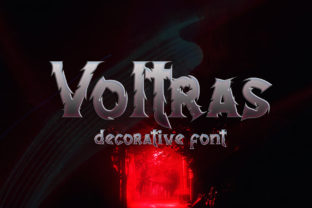
If you’ve ever paused mid-scroll to admire the chilling elegance of a vintage noir film poster—the sharp angles, the high-contrast lettering, the sense that something urgent is about to unfold—you’ve felt the power of typographic storytelling. Voltras captures that exact energy: a decorative font born from the visual language of 1970s thriller cinema, refined for modern digital use. It’s not just “vintage-looking.” It’s deliberately dramatic—tight kerning, exaggerated stroke contrast, subtle asymmetry, and an underlying tension in every glyph. That makes it unusually effective when you need type to do more than label—it needs to set tone, signal intent, and hold attention in crowded visual spaces.
When Tone Is Your First Impression
For creators launching a podcast about unsolved mysteries, designing a limited-edition book cover for a psychological thriller, or building a landing page for a boutique cybersecurity workshop, first impressions hinge on emotional resonance—not just clarity. Voltras communicates urgency and intrigue before a single word is read. Unlike neutral sans-serifs or overused display fonts, Voltras carries narrative weight. A headline in Voltras doesn’t ask to be noticed—it commands space. That’s why freelance designers working with indie authors often reach for it during cover mockups: it helps align typography with genre expectations without leaning into cliché.
Practical Strengths Beyond Aesthetics
Voltras was designed with real-world usability in mind—not just screen drama. Its uppercase-heavy character set includes carefully tuned alternates (like the distinctive slashed “O” and angular “A”) that add variation without sacrificing legibility at larger sizes. At 48px and above, it performs reliably across web and print—no pixelation, no awkward spacing traps. And while it’s decorative, it avoids excessive ornamentation that would hinder readability in short bursts: headlines, album titles, event banners, or social media thumbnails.
Consider a small business owner launching a pop-up immersive theater experience. They need promotional assets that feel cinematic but also function across Instagram carousels, email headers, and physical posters. Using Voltras consistently across those touchpoints builds cohesive recognition—not because it’s “branded,” but because its voice remains unmistakably grounded in mood and pacing. That kind of consistency saves time: fewer font swaps, less A/B testing for emotional alignment, less back-and-forth with clients about “feeling right.”
Who Benefits Most—and Why
Writers and publishers find Voltras especially useful when positioning fiction—particularly in genres where atmosphere drives discovery: crime, suspense, speculative noir, or even stylized historical fiction. A well-set chapter title in Voltras can subtly cue readers about narrative temperature, helping them settle into the rhythm before the first sentence.
Marketers and educators running workshops on storytelling, visual rhetoric, or brand voice sometimes use Voltras as a teaching tool—not to endorse it universally, but to demonstrate how type choices encode values. Its strong personality makes it ideal for exercises comparing tone, hierarchy, and audience perception. One university instructor uses Voltras alongside Helvetica and Playfair Display in a slide deck asking students: “Which font best supports a lecture on moral ambiguity—and why?” The discussion always reveals deeper thinking about intentionality in communication.
Bloggers and content creators covering film, design history, or analog aesthetics often deploy Voltras sparingly—for featured quote graphics or section dividers. Used this way, it adds texture without overwhelming body text set in more functional fonts like Inter or Adobe Serif. That balance—drama where it matters, clarity where it counts—is where Voltras earns its place in a thoughtful toolkit.
Where Voltras Fits—and Where It Doesn’t
Voltras excels in controlled, intentional applications. It’s not meant for body copy, data tables, UI labels, or multilingual interfaces with complex scripts. Its strength lies in brevity and emphasis: a title, a tagline, a logo lockup, a hero banner. If your project requires extended reading, accessibility compliance at small sizes, or support for diacritics beyond basic Latin, Voltras isn’t the solution—and that’s by design. Knowing that limitation upfront prevents misapplication and saves revision time.
It also works best when paired with typefaces that provide contrast—not competition. Think clean, open sans-serifs (like Poppins or IBM Plex Sans) for supporting text, or sturdy serifs (like Crimson Text or Lora) for long-form narrative. Avoid pairing it with other high-contrast decorative fonts; the result can feel cluttered rather than cinematic. One designer shared that she limits Voltras to two weights (Bold and Black) and reserves its italic variant only for isolated words—never full sentences—to preserve its impact.
A Note on Licensing and Implementation
Voltras is available under standard desktop and web font licenses, with clear usage terms for commercial projects. For bloggers embedding it via CSS, self-hosting is recommended over third-party CDNs to ensure consistent rendering and avoid layout shifts. And because its character set is purpose-built—not exhaustive—check glyph coverage early if your project includes symbols, mathematical notation, or non-Latin characters. Most users find the standard Western European set sufficient for editorial, promotional, and branding work.
Why This Kind of Intentionality Matters
In a landscape saturated with interchangeable fonts and AI-generated templates, choosing a typeface like Voltras is a quiet act of curation. It signals that you’re thinking beyond decoration—that you understand how visual cues shape interpretation, how rhythm influences engagement, and how restraint amplifies impact. You’re not selecting Voltras because it’s “trendy.” You’re selecting it because its DNA matches your message’s pulse.
That kind of alignment doesn’t guarantee virality—but it does increase the odds that your audience will pause, lean in, and remember what they saw. For a filmmaker promoting a festival premiere, a journalist launching a long-form investigation series, or a teacher designing a unit on visual persuasion, that moment of connection is where real communication begins.
Voltras won’t solve every design challenge. But when the goal is to evoke unease, suggest momentum, or honor the craft of analog-era graphic design—without nostalgia as a crutch—it offers something few fonts do: authenticity of voice, precision of execution, and immediate recognizability. Use it where meaning hinges on mood—and let the rest of your layout breathe.