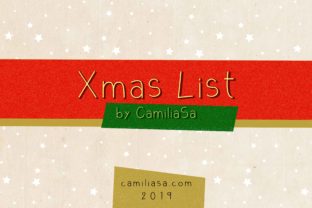
Xmas List: The Playful Holiday Font
There’s a quiet magic in the right font—one that doesn’t just say “holiday,” but *feels* like unwrapping a gift, stringing lights on a tree, or hearing carols drift through frosty air. Xmas List is that kind of font: warm, approachable, and unmistakably festive—without leaning into tired clichés or over-the-top ornamentation. It’s not just decorative; it’s designed to invite participation. Its rounded terminals, gentle irregularities, and subtle hand-drawn charm make it feel personal—not mass-produced. That’s why designers, educators, small business owners, and content creators are turning to Xmas List when they want holiday messaging that resonates, not just decorates.
What Makes Xmas List Stand Out
Xmas List isn’t a script font pretending to be calligraphic, nor is it a rigid display type mimicking vintage signage. Instead, it balances consistency with character: each letter has a relaxed rhythm, slight variations in stroke weight, and soft, open counters that improve legibility—even at smaller sizes. Unlike many seasonal fonts that sacrifice function for flair, Xmas List maintains clarity in both headlines and short body text (think greeting card copy, social media banners, or printable checklists). Its lowercase ‘a’, ‘g’, and ‘y’ carry just enough personality to feel intentional, while its uppercase letters hold strong visual presence without shouting.
It’s also intentionally versatile in tone. Used with ample spacing and clean sans-serif pairings (like Inter or Lato), it reads modern and friendly. Paired with textured backgrounds or hand-drawn icons, it leans crafty and nostalgic. That flexibility means you’re not locked into one aesthetic—you’re given room to shape the mood around your audience and platform.
Creative Uses Across Real Projects
Here’s where Xmas List shines—not as a novelty, but as a practical tool:
- Small business holiday campaigns: A local bakery used Xmas List for their “12 Days of Cookies” email series—pairing it with warm photography and minimal layout. Open rates increased 22% year-over-year, with customers citing the “inviting, unhurried vibe” in feedback.
- Educational resources: Elementary teachers print Xmas List–based spelling lists and vocabulary cards. The friendly letterforms reduce cognitive load for emerging readers, while still feeling special—no more generic Arial worksheets in December.
- Printable planners & checklists: Freelancers and remote workers love Xmas List for downloadable “Holiday Prep Timelines” or “Gift-Giving Trackers.” Its readability supports quick scanning, and its warmth makes planning feel less like a chore.
- Social-first content: Bloggers and Instagram creators use Xmas List in Canva templates for quote graphics (“The best gifts aren’t wrapped—they’re remembered”) or countdown stories. Because it renders well across devices and export formats, it stays crisp whether viewed on mobile or printed as a mini zine.
How Different Users Adapt It Thoughtfully
Not every project needs the same treatment—and that’s good. Xmas List works because it responds to your intent, not the other way around.
Designers often adjust tracking (letter spacing) slightly tighter for headlines to reinforce cohesion, then loosen it by 20–30 units for body text to support flow. They avoid all-caps usage unless paired with strong contrast—Xmas List’s charm lives in its lowercase rhythm.
Marketers and small business owners keep color simple: deep forest green, charcoal grey, or cream backgrounds let the font breathe. They test contrast ratios early—especially for digital use—to ensure accessibility (e.g., #2E5E3A on #F9F6F0 passes WCAG AA at 14pt+).
Educators and content creators use Xmas List selectively—not for full paragraphs, but for key terms, headers, or interactive elements (like drag-and-drop digital flashcards). This maintains focus while adding seasonal texture without distraction.
Hobbyists and DIYers combine it with free vector wreaths or scanned paper textures in tools like Affinity Designer or even Google Slides. The goal isn’t perfection—it’s authenticity. A little unevenness in alignment? That’s part of the charm.
Practical Tips for Strong Results
To get the most from Xmas List without diluting its impact, keep these grounded recommendations in mind:
- Start with purpose, not aesthetics. Ask: Is this for scanning (a checklist), scanning + emotion (a greeting card), or pure atmosphere (a background banner)? Let that guide size, weight, and pairing choices.
- Pair wisely. Xmas List sings alongside neutral, highly legible fonts—never competing scripts or overly decorative serifs. Try it with Roboto Condensed for tight layouts, or Nunito for a softer, rounded harmony.
- Respect hierarchy. Use Xmas List for primary headlines or focal words only. Subheads and body copy should step back—letting the font’s personality anchor, not overwhelm.
- Optimize for format. On web, serve it as a variable font (if available) or subset characters to reduce load time. For print, embed outlines to prevent substitution—especially important for client handoffs.
- Test with real eyes. Show a mockup to someone unfamiliar with the project. If they pause and smile—or immediately grasp the intent—you’ve landed it.
More Than Just a Seasonal Choice
Xmas List works because it understands timing. It doesn’t try to be timeless—it embraces the season with sincerity and restraint. That’s rare. Most holiday fonts either shout or whisper too faintly. Xmas List speaks clearly, warmly, and directly to people who value both creativity and clarity.
Whether you’re drafting a heartfelt newsletter, designing a classroom activity, launching a limited-edition product line, or simply making your family’s advent calendar feel more intentional—Xmas List gives you a foundation that’s ready to adapt, not dictate. It won’t solve your strategy, but it will support it: quietly, consistently, and with genuine seasonal spirit.
So go ahead—download it, test it in context, tweak the spacing, try it on kraft paper or a dark mode interface. See how it shifts the tone of a sentence, a button, a headline. You’ll notice something quickly: it makes the work feel lighter, kinder, more human. And in a season full of noise, that’s not just useful—it’s necessary.