Hellowin: A Playful Yet Refined Halloween Font for Designers
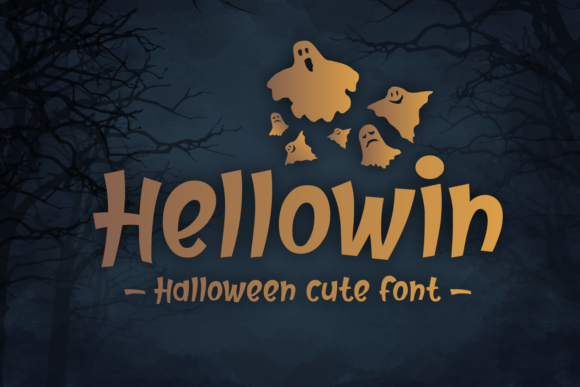
Hellowin is a decorative display font designed specifically for Halloween-themed projects. It balances whimsy and craftsmanship—featuring exaggerated letterforms, subtle spookiness (think gentle curves reminiscent of cobwebs or flickering candlelight), and consistent spacing that supports readability at larger sizes. Unlike many seasonal fonts that rely heavily on clichés like dripping blood or jagged edges, Hellowin maintains typographic integrity while evoking the spirit of the holiday through proportion, rhythm, and restrained ornamentation.
Designers often seek fonts like Hellowin when they need to convey seasonal relevance without sacrificing professionalism or visual cohesion. Its appeal lies in its dual nature: it reads clearly as “Halloween” at a glance, yet avoids visual fatigue that can come with over-the-top novelty typefaces. This makes it especially relevant for creators working across print, digital, and physical media—including invitations, social media graphics, packaging, signage, and craft-based decor.
Why Consider Hellowin?
Several practical factors make Hellowin worth evaluating alongside other Halloween fonts:
- Legibility at scale: The font’s open counters and generous x-height support clarity in large-format applications—such as window decals, banners, or poster headlines—without requiring manual kerning adjustments.
- Consistent weight and contrast: Unlike some hand-drawn alternatives, Hellowin uses balanced stroke contrast and uniform weight distribution, making it easier to pair with body text fonts (e.g., sans-serifs or clean serifs) without clashing.
- Character set completeness: It includes standard Latin characters, numerals, basic punctuation, and common accented letters—sufficient for English-language use and many bilingual contexts (e.g., Spanish or French event materials).
- File format compatibility: Available in widely supported formats (WOFF2, OTF, TTF), Hellowin integrates smoothly into design workflows using Adobe Creative Cloud, Figma, Canva, or web development environments.
Tradeoffs and Realistic Expectations
No display font is universally suitable—and Hellowin is no exception. Its strengths are most apparent in headline and accent roles; it is not intended for extended body text. Attempting to use it for paragraphs, captions, or small UI labels will compromise readability and accessibility.
Additionally, while Hellowin avoids extreme novelty, its stylistic cues remain distinctly seasonal. That means it has limited reuse value outside October or Halloween-adjacent themes (e.g., Day of the Dead, autumn festivals). If your project requires year-round flexibility—or needs to resonate across multiple cultural or seasonal contexts—this may reduce its long-term utility.
Licensing is another practical consideration. Hellowin is typically offered under a commercial license, which permits use in client work, merchandise, and promotional materials—but always verify the specific license terms before deployment. Free versions, if available, often restrict usage to personal projects or lack full character support.
When Hellowin Fits Well
Hellowin performs best in situations where tone, timing, and visual hierarchy align:
- Seasonal marketing campaigns: Retailers launching Halloween product lines, cafes promoting themed menus, or event venues advertising haunted attractions can use Hellowin to anchor visual identity without appearing gimmicky.
- Craft and DIY projects: Because of its clean outlines and predictable metrics, Hellowin cuts well on vinyl plotters and laser engravers—making it suitable for custom signs, stencils, or embroidered patches.
- Social media visuals: Its expressive yet controlled appearance translates effectively to square and vertical image formats, helping posts stand out in feeds without relying on heavy filters or overlays.
- Editorial design: Magazines, newsletters, or blogs covering seasonal topics may apply Hellowin sparingly—for section headers or pull quotes—to reinforce theme while preserving overall typography harmony.
When Alternatives May Be More Appropriate
Consider other options if any of the following apply:
- You need multilingual support beyond Western European languages: Hellowin does not include extended Cyrillic, Greek, or East Asian character sets. Fonts like Creepster (with broader language coverage) or custom-commissioned type may better serve global audiences.
- Your brand voice prioritizes minimalism or restraint: If Halloween elements must feel subtle or ironic—rather than festive or playful—cleaner sans-serif treatments with Halloween-inspired color palettes or iconography may communicate more effectively.
- You’re designing for accessibility-first contexts: For users relying on screen readers or low-vision accommodations, decorative fonts—even high-quality ones like Hellowin—should never replace semantic HTML headings and accessible fallbacks. Prioritize structural clarity over stylistic flair in these cases.
- You require variable font capabilities: Hellowin is currently released as a static font family (typically one weight). Projects needing responsive weight shifts (e.g., dynamic web typography that adjusts boldness based on viewport size) would benefit from variable alternatives—or pairing Hellowin with a compatible variable sans-serif for body copy.
Making an Informed Choice
Evaluating Hellowin isn’t about whether it’s “good” in absolute terms—it’s about whether it serves your specific purpose. Start by clarifying your core requirements: What’s the medium? Who is the audience? How long will the design remain in use? What role does typography play relative to imagery, color, and layout?
Test Hellowin in context early. Import it into your design tool and simulate real usage: render it at intended sizes, check contrast against background colors, and assess how it pairs with supporting typefaces. Compare side-by-side with alternatives—not just for aesthetics, but for technical fit (e.g., file size for web use, rendering consistency across browsers and devices).
Finally, remember that typography supports communication—it doesn’t replace it. A well-chosen font like Hellowin enhances message delivery, but clarity, accuracy, and user-centered design remain foundational. If your goal is to evoke warmth, playfulness, and seasonal recognition without undermining legibility or professionalism, Hellowin merits serious consideration. If your priorities lie elsewhere—such as neutrality, longevity, or linguistic breadth—other fonts may better match your objectives.