Dazed: When Handwritten Charm Meets Cosmic Typography
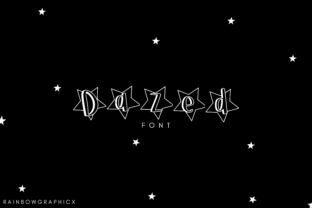
Typography isn’t just about legibility—it’s about resonance. It’s the quiet hum beneath a brand’s voice, the subtle gesture that tells a reader whether they’re stepping into a boardroom, a studio, or a starlit backyard. Among the thousands of typefaces released each year, few land with the kind of quiet magnetism that Dazed does. Designed not for neutrality but for personality, Dazed is a fun and charming handwritten font that will make the stars align—not through astrology, but through intentionality, warmth, and unexpected harmony.
A Typeface That Breathes Like a Human
At its core, Dazed is built on authenticity—not perfection. Its letterforms carry slight variations in stroke weight, gentle inconsistencies in baseline alignment, and soft, organic terminals that mimic the natural lift and pause of ink on paper. Unlike many “handwritten” fonts that rely on rigid alternates or mechanical randomness, Dazed feels like it was drawn once—by someone who paused to smile mid-sentence, who let their wrist sway just enough to soften an ‘s’, who trusted rhythm over repetition.
This isn’t decorative whimsy. It’s typographic empathy. Each character has breathing room. The lowercase ‘a’ opens wide; the ‘g’ curls with quiet confidence; the ampersand is a tiny constellation unto itself. These aren’t flourishes added after the fact—they’re structural choices rooted in how people actually write when they’re relaxed, expressive, and present.
Where Dazed Finds Its Ground—and Its Glow
Dazed thrives where clarity meets character. It’s rarely the right choice for dense legal disclaimers or multi-column technical documentation—but it shines precisely where human connection matters most. Consider these real-world applications:
- Creative branding: A ceramicist launching a new line of moon-phase mugs might use Dazed for her shop banner and product tags—immediately signaling craftsmanship, care, and tactile joy.
- Educational outreach: A science museum designing a summer camp brochure could pair Dazed headlines with a clean sans-serif body text, making astrophysics feel approachable and wonder-filled—not intimidating.
- Small business storytelling: A neighborhood bookstore curating a “Staff Picks” shelf might hand-letter (digitally, via Dazed) short blurbs on chalkboard-style cards—inviting readers in without demanding attention.
- Digital experiences: When used sparingly in UI—like a celebratory microcopy message (“You’re all set! ✨”) or a personalized onboarding step—Dazed adds emotional texture without compromising usability.
What unites these uses isn’t genre—it’s contextual sincerity. Dazed doesn’t shout. It leans in. And because it avoids caricature (no exaggerated loops, no forced “grunge” textures), it retains dignity across formats—from a laser-etched wooden sign to a responsive email header.
Why Designers Reach for Dazed—Not Just Once, But Repeatedly
Professionals choose Dazed not because it’s trendy, but because it solves recurring problems:
- Breaking visual fatigue: In interfaces saturated with geometric sans-serifs and algorithmically optimized UI fonts, Dazed offers cognitive relief—a moment of warmth that slows scrolling just long enough to register meaning.
- Humanizing automation: Chatbots, AI-generated reports, and dashboard alerts often feel transactional. Adding Dazed to non-critical, high-emotion microcopy (“Your idea just landed!” or “Let’s begin together”) reminds users there’s still a person behind the process.
- Scaling intimacy: Startups and solopreneurs need to project trust without corporate polish. Dazed helps them appear accessible—not amateurish—because its imperfections read as humility, not haste.
Importantly, Dazed performs well across devices. Its generous x-height and open counters ensure readability even at smaller sizes—say, 18px on mobile—while its expressive details hold up beautifully at display scale. It’s not a one-trick font; it’s a versatile collaborator.
Who Benefits Most—And Why It’s Not Just for “Creative Types”
While designers and marketers are early adopters, Dazed’s utility extends far beyond traditional creative roles:
- Educators use it to design classroom posters that feel inviting rather than authoritarian—think astronomy unit headers where “Nebulae” curves like stardust, or a gentle reminder: “Ask questions. Wonder often.”
- Researchers presenting qualitative findings sometimes include verbatim participant quotes in Dazed—visually distinguishing lived experience from analytical text, reinforcing respect for voice over data abstraction.
- Hobbyists building personal websites (a gardener documenting seasonal growth, a knitter sharing pattern notes) find Dazed bridges the gap between craft and content—making their digital space feel like an extension of their physical studio.
- Business owners in service-based fields—therapists, consultants, holistic practitioners—leverage Dazed in welcome emails and session summaries to reinforce warmth, continuity, and presence—qualities clients actively seek.
This broad adoption isn’t accidental. Dazed avoids cultural or generational coding—its charm isn’t tied to a specific decade, subculture, or aesthetic movement. It feels timeless because it mirrors something universal: the irregular beauty of human expression.
Practical Considerations Before You Type “Dazed”
Like any expressive tool, Dazed rewards thoughtful application. Here’s what seasoned users observe:
First, pairing matters. Dazed sings when contrasted—not matched. Pair it with a neutral, highly legible typeface for body text: think Inter, Lora, or even system fonts like San Francisco or Segoe UI. Avoid other decorative or script fonts nearby; Dazed needs room to breathe and be understood.
Second, scale with purpose. Its strength lies in moderate-to-large sizes (24px and up for web, 18pt+ for print). Using it below 16px risks losing its nuance and can strain readability—especially for readers with visual impairments or those viewing on low-resolution screens.
Third, language support is evolving. The standard release covers Latin-based languages comprehensively—including accented characters used in French, Spanish, Portuguese, German, and Scandinavian languages. However, extended Cyrillic, Greek, or CJK support isn’t native. Users working multilingually should verify glyph coverage for their target audience before full implementation.
Finally, licensing is straightforward but essential. Dazed is available under both desktop and web licenses, with clear terms for commercial use—including SaaS platforms and client projects. There’s no “free trial” version that limits features or embeds watermarks, which eliminates last-minute licensing surprises during handoff.
Looking Up—Beyond Aesthetics, Toward Intention
In an age of algorithmic feeds and templated designs, choosing a font like Dazed is quietly radical. It signals that the creator values feeling as much as function—that they understand typography as part of a larger sensory ecosystem. When a nonprofit uses Dazed in its donor thank-you note, it doesn’t just say “thank you”—it says, “I see you as a person, not a metric.” When a teacher writes “You’ve got this” in Dazed on a student’s feedback form, the handwriting quality makes the encouragement feel witnessed, not automated.
That’s the deeper power of Dazed: it invites alignment—not astrological, but ethical. It asks the user to consider why this message exists, who it serves, and how it lands in the body and mind of the reader. It doesn’t solve complex problems by itself—but it makes space for solutions that feel human-scaled, emotionally honest, and gently luminous.
So whether you’re drafting a grant proposal, designing a workshop handout, scripting a podcast intro, or labeling jars of homemade lavender honey—consider Dazed not as decoration, but as dialogue. As a way to say, without saying a word: We made this with care. We meant for you to feel something here. The stars didn’t align by accident—we helped them.