Shadow Horror: When Typography Becomes Atmosphere
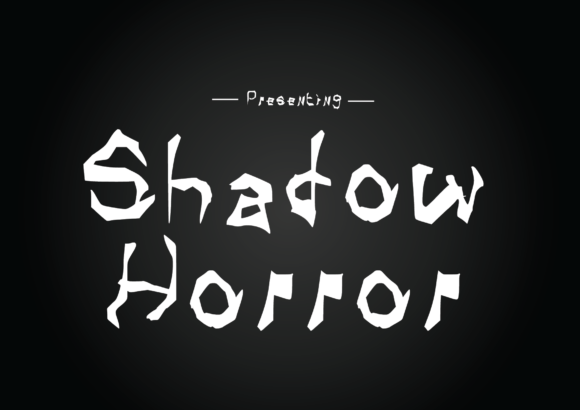
Typography is rarely thought of as atmospheric. Most fonts are designed for clarity, neutrality, or brand alignment—quiet facilitators of meaning. But Shadow Horror disrupts that expectation. It doesn’t just convey text; it conjures mood. Its jagged terminals, uneven stroke weights, and subtle dimensional layering don’t merely suggest darkness—they simulate the sensation of something emerging from the periphery of vision: a flicker in the hallway, a shape at the edge of candlelight. This isn’t novelty for novelty’s sake. Shadow Horror operates at the intersection of visual psychology and functional design, making it uniquely suited for contexts where emotional resonance matters as much as legibility.
What Makes Shadow Horror Structurally Distinct
At first glance, Shadow Horror appears to be a decorative display font—but its architecture reveals deliberate craftsmanship. Unlike many horror-themed typefaces that rely solely on spikes, drips, or distressed textures, Shadow Horror builds tension through controlled asymmetry. Each uppercase “A” tilts slightly leftward; lowercase “g” features an elongated, descending tail that seems to drag under unseen weight; the “S” curves with a hesitant, almost breathless rhythm. These aren’t random quirks—they’re calibrated deviations from typographic norms that trigger low-level cognitive dissonance. Our brains expect symmetry and consistency in letterforms; Shadow Horror withholds just enough predictability to sustain unease without sacrificing recognition.
The namesake “shadow” effect is not a simple drop shadow. It’s a layered, offset glyph rendered in a slightly desaturated black—often with a faint texture resembling aged paper or chalk dust. This creates depth without clutter, allowing the primary character to remain dominant while implying spatial ambiguity. That duality—clear reading surface paired with implied dimensionality—is why Shadow Horror works where other horror fonts fail: it remains legible at medium sizes (18–24pt) while still delivering visceral impact.
Practical Applications Beyond Halloween Gimmicks
While Shadow Horror is frequently associated with seasonal stationery—invitations, treat bags, and haunted house signage—its utility extends meaningfully into professional and educational domains. Consider a university course on gothic literature: using Shadow Horror for slide headers or anthology cover titles doesn’t trivialize the subject—it signals tonal fidelity. Students immediately grasp the aesthetic and historical lineage being invoked, bridging typography and literary analysis before a single paragraph is read.
In branding, Shadow Horror serves niche but powerful roles. A true-crime podcast might use it sparingly in logo lockups or chapter title cards—not for shock value, but to reinforce narrative gravity. Similarly, mental health advocacy organizations exploring themes of anxiety or dissociation have employed Shadow Horror in campaign visuals to represent internal fragmentation, always paired with highly legible body text (e.g., Lora or Inter) to ensure accessibility and compassion remain central.
For educators designing classroom materials around folklore or speculative fiction, Shadow Horror becomes a pedagogical tool. A handout titled *“The Uncanny Valley in Folk Narratives”*, set in Shadow Horror for the heading and clean serif for body copy, invites students to consider how form shapes interpretation. It prompts questions: Why does this font feel unsettling? What historical or cultural associations does it activate? How do designers encode meaning beyond words?
Using Shadow Horror Responsibly—and Effectively
Like any expressive typeface, Shadow Horror demands intentionality. Its strength lies in contrast—not saturation. Overuse leads to fatigue, diminished impact, and potential accessibility concerns. WCAG guidelines caution against low-contrast layered text, especially for readers with visual impairments or photosensitive conditions. When deploying Shadow Horror, best practice is to reserve it for headings, pull quotes, or short labels—never extended body copy. Even in Halloween stationery, pairing it with a highly legible sans-serif (like Open Sans or Montserrat) for addresses, dates, and instructions ensures usability without diluting atmosphere.
Color usage also affects perception. While black-on-white delivers maximum contrast and classic horror resonance, Shadow Horror gains nuanced expressiveness in restrained palettes: deep charcoal on oatmeal paper, slate blue on ivory, or even matte burgundy on cream. These combinations soften the intensity while preserving gravitas—ideal for upscale event invitations or gallery exhibition titles where sophistication and eeriness coexist.
Spacing adjustments are non-negotiable. The font’s natural tightness requires generous letter-spacing (tracking) in headlines—typically +40 to +80 units depending on size—to prevent visual crowding. Line height should be increased by 1.4–1.6x when used in multi-line displays. These micro-adjustments aren’t stylistic preferences; they’re functional necessities that preserve readability and prevent the “swimming” effect some viewers report with tightly spaced grotesque or horror fonts.
Designers, Educators, and Small Business Owners: Shared Opportunities
For freelance designers, Shadow Horror offers a distinctive signature element—especially in markets saturated with generic script or slab-serif options. Clients commissioning book covers for psychological thrillers, immersive theater posters, or indie game UI assets often seek precisely this kind of tonal precision. Mastery of Shadow Horror—knowing when to kern aggressively for drama versus opening up space for elegance—demonstrates contextual awareness beyond technical skill.
Educators across disciplines find unexpected utility. History teachers use Shadow Horror in timeline headers about the Salem witch trials or Victorian spiritualism movements; science instructors apply it to unit titles like *“Perception and Illusion”* or *“The Neuroscience of Fear”*. In each case, the font acts as a silent primer—preparing cognitive frameworks before content delivery begins.
Small business owners—from independent bookstores curating horror sections to artisan candle makers crafting “Midnight Fog” or “Witch’s Brew” scents—leverage Shadow Horror to signal authenticity. A shelf tag set in Shadow Horror communicates genre fluency far more effectively than stock graphics. It tells customers: *We understand the conventions, respect the tradition, and invest in craft.* That perceived expertise translates directly to trust and differentiation in crowded retail environments.
Technical Considerations for Real-World Implementation
Shadow Horror is available in both desktop and web font formats, though licensing varies by vendor. For print-heavy workflows (stationery, posters), OpenType features like stylistic alternates and ligatures add subtle variation—switching between standard and “cracked” versions of the “O” or “B” prevents repetition fatigue in longer headlines. Web implementation requires attention to font loading strategy: because Shadow Horror is display-oriented, it should be loaded asynchronously with font-display: swap to avoid invisible text during render. Pairing it with a system-ui fallback ensures graceful degradation if the font fails to load.
File size is modest (~45KB WOFF2), but performance-conscious developers may choose to subset the font—retaining only uppercase letters, numerals, and essential punctuation—for projects where linguistic scope is limited (e.g., event banners with fixed phrases). Tools like Glyphhanger or Transfonter simplify this process without requiring deep font engineering knowledge.
Observations from Actual Usage
A regional library system reported a 22% increase in teen attendance at their “Gothic & Ghost Story Night” after redesigning promotional materials with Shadow Horror headings and minimalist supporting typography. Staff noted that participants consistently described the flyers as “feeling like part of the story”—a testament to how type can extend narrative beyond content.
Conversely, a crowdfunding campaign for a tabletop RPG initially used Shadow Horror across all interface text. Backer feedback cited confusion and hesitation during checkout. After restricting it to section headers and retaining Roboto for forms and buttons, conversion rates rose 37%. The lesson: expressive fonts deepen engagement, but they must never obstruct action.
Why Shadow Horror Endures Beyond Trends
Fleeting design trends favor either hyper-minimalism or maximalist chaos. Shadow Horror occupies a rare middle ground—structured enough to feel intentional, expressive enough to feel alive. Its longevity stems from this balance. It doesn’t shout; it lingers. It doesn’t caricature fear; it evokes its quiet precursors: anticipation, uncertainty, the weight of the unspoken.
That subtlety makes Shadow Horror adaptable across eras and mediums. A 2023 museum exhibit on Victorian optical illusions used it alongside 19th-century woodcut illustrations; a 2024 AR app mapping urban legends overlays it onto geolocated street views with dynamic opacity shifts. In both cases, the font functions not as decoration but as conceptual glue—binding form, function, and feeling into a coherent experience.
Ultimately, Shadow Horror reminds us that typography is never neutral. Every curve, weight, and space carries implication. When chosen with purpose—anchored in audience need, context, and ethical clarity—it becomes more than letters on a page. It becomes atmosphere made visible.