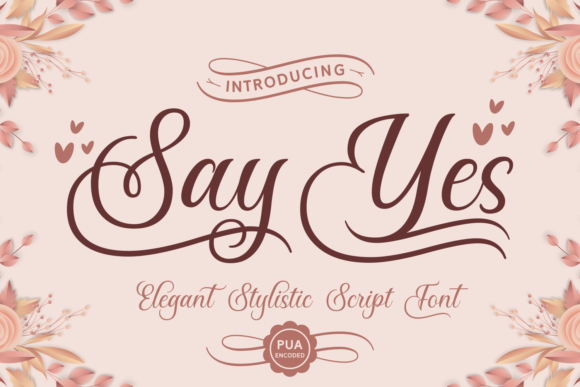
Say Yes: An Elegant Script Font for Romantic Typography
Say Yes is a carefully crafted script font designed to evoke elegance, intimacy, and timeless romance. Its letterforms feature smooth, unbroken strokes, gentle tapering, and harmonious spacing—characteristics that lend themselves well to expressive, emotionally resonant typography. Unlike display-oriented scripts with exaggerated flourishes, Say Yes balances decorative appeal with functional legibility at moderate sizes, making it suitable for both digital and print applications where tone and personality matter.
Why Designers and Communicators Consider Say Yes
People often explore Say Yes when they need type that conveys warmth, sincerity, or personal connection. It’s commonly evaluated for wedding stationery, boutique branding, artisan packaging, lifestyle blogs, and invitation design—contexts where visual language reinforces emotional intent. Its flowing curves suggest movement and continuity, subtly reinforcing messages of commitment, celebration, or affection.
Unlike monoline or geometric scripts, Say Yes includes subtle contrast in stroke weight and natural entry/exit terminals. This gives it organic rhythm without sacrificing clarity. For readers comparing script fonts, these details help distinguish Say Yes from more stylized or highly decorative alternatives.
Practical Benefits and Realistic Tradeoffs
One strength of Say Yes is its consistency across weights and styles—though it is typically offered as a single-weight script, its internal rhythm and spacing support predictable line-height behavior and even text flow in short passages. Its lowercase forms connect fluidly, supporting a cohesive reading experience in headlines or short phrases.
However, users should expect limitations common to most elegant script fonts. Say Yes is not optimized for extended body text. Its connected letters and low x-height reduce readability in paragraphs or small sizes (below 16px on screen or 10pt in print). It also lacks extensive language support beyond basic Latin characters, so multilingual projects may require fallback fonts or custom glyph additions.
Another consideration: Say Yes performs best when paired with neutral, highly legible sans-serif or serif companions. Using it alongside similarly decorative typefaces risks visual competition and diminished hierarchy. Designers evaluating Say Yes should test how it interacts with supporting fonts in real layouts—not just isolated specimens.
When Say Yes Aligns Well With Your Goals
Say Yes is a strong fit when your primary objective is to reinforce an emotional message through typography alone. For example:
- Creating wedding invitations where the couple’s names appear prominently and benefit from graceful, hand-crafted emphasis;
- Designing a luxury skincare brand’s tagline or product name that aims to feel personal and artisanal;
- Developing social media graphics for a relationship coach or wedding planner seeking visual consistency with themes of connection and authenticity;
- Producing limited-edition book covers or chapbooks centered on love, poetry, or memoir.
In each case, Say Yes functions as a deliberate stylistic choice—not merely decoration, but part of the communicative strategy. Its effectiveness increases when used sparingly and intentionally, allowing its character to resonate without overwhelming surrounding content.
When Alternatives May Be More Suitable
If your project requires versatility across multiple typographic roles—such as headings, subheadings, captions, and body copy—Say Yes alone will likely fall short. In those cases, consider pairing it with a robust text font family, or exploring script fonts with expanded language support, optical sizing, or variable axes (e.g., weight or width control).
For digital interfaces with dynamic content—like user-generated wedding RSVP forms or CMS-driven blogs—Say Yes may pose technical constraints. Web font loading, rendering inconsistencies across browsers, and accessibility considerations (e.g., screen reader compatibility with decorative text) warrant testing before full implementation.
Additionally, if your audience includes readers with dyslexia or low vision, prioritize fonts with higher legibility metrics. While Say Yes is not inherently inaccessible, its stylistic features—tight letter spacing, low contrast, and connected forms—can hinder rapid character recognition. In such contexts, a simpler script or a clean serif/sans-serif combination may better serve inclusivity goals.
Making an Informed Decision
Evaluating Say Yes isn’t about determining whether it’s “good” or “bad”—it’s about assessing alignment between its formal qualities and your specific communication needs. Start by clarifying your core objectives: Is the goal to evoke emotion, establish brand voice, support narrative tone, or fulfill a functional requirement like readability or localization?
Next, examine usage context. Will the font appear in static PDFs, responsive web layouts, or physical print? Each medium introduces different constraints—rendering fidelity on mobile screens, ink spread on uncoated paper, or variable font loading performance. Test Say Yes in realistic conditions, not just specimen pages.
Also consider workflow implications. Does your team have access to OpenType features like ligatures or contextual alternates? Are you using platforms that support custom font uploads (e.g., WordPress with self-hosted fonts) or restricted environments (e.g., email clients with limited web font support)? These factors influence whether Say Yes can be deployed reliably.
Finally, reflect on longevity. Script fonts tied closely to current aesthetic trends may date quickly. Say Yes, with its restrained curves and balanced proportions, leans toward timelessness—but no font exists outside cultural context. Ask whether its romantic tone remains appropriate if your brand evolves or your audience broadens.
Conclusion: A Purposeful Choice, Not a Default
Say Yes stands out among script fonts for its refined execution and intentional restraint. It doesn’t shout; it invites attention through subtlety and cohesion. That makes it valuable—but only when matched thoughtfully to purpose, audience, and medium.
Before committing, download a trial version and apply it to actual content—not placeholder text. Compare it side-by-side with alternatives like Great Vibes, Playlist Script, or Reenie Beanie, noting differences in spacing, rhythm, and visual weight. Pay attention to how each feels in context: Does it clarify meaning or distract from it? Does it enhance your message—or compete with it?
Typography is never neutral. Choosing Say Yes signals a decision to prioritize emotional resonance and aesthetic harmony. When that matches your goals, it can elevate design meaningfully. When it doesn’t, recognizing that early saves time, resources, and creative misalignment.