Eliya: A Handwritten Font That Builds Connection—Not Just Decoration
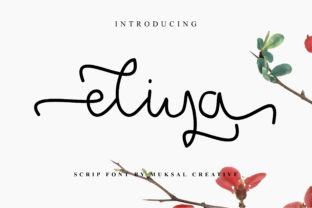
Eliya is a sweet and fun handwritten font with a cool vibe—but that description barely scratches the surface of its strategic utility. It’s not just another decorative typeface you drop into a social post for “personality.” Eliya works best when treated as a deliberate communication tool: one that signals approachability, warmth, and human intention. For entrepreneurs launching a new service, educators designing learning materials, or small business owners refining their brand voice, Eliya isn’t about aesthetics alone—it’s about aligning visual tone with relational goals.
Why Eliya Fits Real-World Goals—Not Just Trends
Most fonts communicate passively. Eliya communicates actively. Its slight irregularity, gentle slant, and soft curves mimic natural handwriting—not perfectly uniform, but confidently human. That matters when your objective is trust-building, not just attention-grabbing. Consider this: a wellness coach sending a client onboarding email might choose Eliya for headers and short callouts because it softens formality without sacrificing clarity. The same font in a legal disclaimer? Misaligned. In a handwritten-style thank-you note embedded in a Shopify order confirmation? Highly effective.
The strategic value lies in consistency paired with context. Eliya doesn’t replace your primary brand font—it complements it. Use it where warmth amplifies intent: welcome messages, workshop invitations, story-driven landing page sections, or illustrated resource guides. When used this way, Eliya supports outcomes—not just visuals. It helps audiences feel seen, not sold to.
When Eliya Strengthens—And When It Undermines—Your Positioning
Eliya strengthens positioning when it reflects an authentic part of your voice. A children’s book illustrator using Eliya in chapter titles reinforces playfulness and care. A freelance copywriter embedding Eliya in a case study’s pull quotes adds emphasis while preserving readability. But it undermines positioning when applied without purpose: slapped across a corporate annual report, layered over low-contrast backgrounds, or scaled too small for body text. Those uses don’t fail because Eliya is “bad”—they fail because they ignore functional hierarchy and audience expectation.
Ask yourself before deploying Eliya: What action do I want the reader to take after seeing this? If the answer is “feel reassured,” “pause and reflect,” or “connect emotionally before reading further,” Eliya may be well-suited. If the goal is “scan quickly for pricing tiers” or “compare technical specs side-by-side,” a clean sans-serif will serve you better.
Practical Integration: Planning Before Placement
Start with use-case mapping—not font pairing. List the top three places your audience interacts with your written content: email subject lines, Instagram carousels, PDF workbooks, product packaging, or printed workshop handouts. Then ask: In which of these does human warmth directly support my objective? That’s where Eliya earns its place.
- Email headers: Use Eliya at 28–36px for subject line previews or hero banners—never for body copy. Pair with a highly legible sans-serif (like Inter or Open Sans) for paragraphs.
- Social graphics: Apply Eliya only to short, high-impact phrases—“You’ve got this,” “Let’s begin,” or “Just for you.” Avoid full sentences or multi-line blocks.
- Printed materials: Test print resolution first. Eliya performs best on coated paper or high-DPI digital displays. On newsprint or low-res screens, its subtlety can blur into ambiguity.
Also consider accessibility: Eliya is not suitable for WCAG-compliant body text. Its variable stroke width and connected letterforms reduce legibility for some readers, especially at smaller sizes or against busy backgrounds. Reserve it for large, high-contrast, short-form applications—and always provide fallbacks in your CSS or design system.
Risks of Using Eliya Without Strategic Guardrails
Using Eliya randomly—without alignment to message, medium, or audience—introduces three quiet risks:
- Tone drift: A financial advisor using Eliya in a retirement planning guide may unintentionally signal informality where credibility and precision are expected.
- Reduced scannability: On mobile devices, Eliya’s fluid forms can slow comprehension in dense layouts—especially if line spacing or contrast isn’t carefully adjusted.
- Brand dilution: Overuse across every touchpoint flattens differentiation. When everything feels “handwritten,” nothing feels intentional.
None of these are flaws in Eliya itself—they’re symptoms of misalignment between tool and intention. The font doesn’t need to be “fixed.” Your usage plan does.
How Eliya Supports Long-Term Brand Clarity
Brands that endure aren’t built on trend-chasing—they’re built on consistent, values-aligned expression. Eliya contributes to that clarity when used as a signature accent, not a default. Think of it like a well-chosen phrase in a speech: not repeated constantly, but deployed at moments where emotional resonance matters most.
For example, a sustainable skincare brand might use Eliya exclusively in its “Ingredient Stories” section—where each botanical is introduced with a short, handwritten-style note (“This chamomile was harvested at dawn, just before the dew lifted”). That use reinforces care, craft, and transparency. It doesn’t appear in ingredient lists, shipping policies, or lab test summaries—because those demand neutrality and precision.
This kind of restraint builds recognition over time. Audiences begin to associate Eliya not with “cute fonts,” but with moments of human-centered storytelling in your ecosystem. That association becomes a subtle, repeatable asset—especially as competitors rely on generic stock visuals or algorithm-friendly templates.
Decision-Making Guidance: Three Questions Before You Use Eliya
Before opening your design file or CSS editor, pause and answer these honestly:
- Does this application prioritize emotional connection over speed or scale? If yes, Eliya is worth testing. If the priority is rapid information transfer, skip it.
- Is the text short enough—and the context clear enough—that Eliya won’t compete with meaning? Five words? Likely fine. Fifty? Reconsider.
- Does this usage reinforce, rather than contradict, how my audience already experiences my voice elsewhere? If your website copy is warm but precise, and your emails are structured and actionable, Eliya fits naturally in subject lines or CTA buttons—not long-form newsletters.
These questions shift focus from “Does this look nice?” to “Does this serve the outcome I’m trying to create?” That’s where real typography strategy begins.
Final Thought: Eliya Is a Choice—Not a Default
Eliya invites intentionality. It rewards practitioners who understand that every visual decision either clarifies or clouds. It doesn’t promise virality, conversions, or instant trust—but it can deepen authenticity when matched thoughtfully to purpose, platform, and people. Use it where humanity matters more than uniformity. Apply it where warmth accelerates understanding—not where it obscures it. And above all, treat it not as decoration, but as dialogue: a quiet, confident way to say, “I’m speaking to you—not at you.”