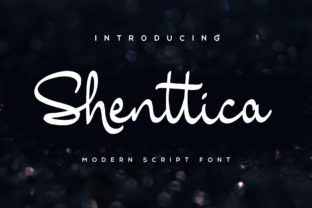
Shenttica: A Handwritten Font with Personality
If you’ve ever scrolled through font libraries searching for something that feels human—not stiff, not sterile, but genuinely expressive—then you’ve probably paused on Shenttica. It’s not just another script font. It’s a handwritten typeface built with rhythm, intention, and a subtle, clever twist that sets it apart from the crowd.
Shenttica balances authenticity with polish. Its letterforms are drawn by hand—no algorithmic smoothing, no forced uniformity—but refined just enough to ensure clarity and consistency across sizes and contexts. That “cool twist”? It’s in the unexpected flourishes: a tapered crossbar on the lowercase t, a lifted exit stroke on the s, or the gentle asymmetry in how letters connect. These aren’t gimmicks—they’re intentional details that give Shenttica its voice.
Why Designers and Communicators Reach for Shenttica
Professionals don’t choose fonts based on aesthetics alone. They choose tools that solve problems—and Shenttica solves several at once. It conveys warmth without sacrificing professionalism. It stands out in digital spaces where generic sans-serifs dominate feeds and interfaces. And because it’s carefully spaced and kerned, it remains legible even at smaller sizes—unlike many decorative scripts that blur into illegibility below 24px.
For marketers, that means better engagement on social graphics or email headers. For educators, it adds approachability to lesson plans or student-facing materials without undermining authority. For freelancers and small business owners, Shenttica helps build visual distinction fast—especially when budget and time limit custom branding options.
Where Shenttica Fits Naturally (and Where It Doesn’t)
Shenttica shines brightest in contexts where personality matters more than neutrality:
- Branding accents: Logos rarely benefit from full-script treatment, but Shenttica works beautifully as a secondary wordmark (e.g., “Est. 2023” beneath a clean primary logo) or in taglines (“Made with care”, “Think differently”).
- Digital storytelling: Blog headers, newsletter banners, or landing page subheadings gain instant character—without slowing down load times (it’s a lightweight OTF/TTF).
- Educational resources: Worksheets, flashcards, or presentation slides feel more inviting when key terms or instructions use Shenttica—particularly in early education or wellness coaching.
- Printed collateral: Wedding invites, artisan product labels, or indie zines gain tactile authenticity. Its slight irregularity reads as handmade, not automated.
That said, Shenttica isn’t meant for body text, legal disclaimers, or data-dense tables. Its charm lies in contrast—not continuity. Pair it thoughtfully: a crisp sans-serif like Inter or Lato for supporting text keeps hierarchy clear and maintains accessibility.
Real Use Cases You Can Adapt Today
A freelance graphic designer used Shenttica for a local bakery’s seasonal menu board—hand-lettered specials like “Honey Lavender Loaf” stood out instantly against chalkboard backgrounds, increasing dwell time and social shares. No custom illustration needed.
An online course creator applied Shenttica to section dividers in their Notion workspace (“Week 3: Build Your System”)—a small touch that made the structure feel more personal and less transactional. Students reported higher completion rates that module.
A boutique publisher chose Shenttica for chapter titles in a memoir about creative recovery. The font’s organic flow mirrored the author’s narrative voice—readers mentioned “feeling the writer’s hand behind the words.”
What Makes Shenttica More Than Just “Cute”
Its strength isn’t novelty—it’s nuance. Unlike many handwritten fonts that rely on excessive swashes or exaggerated bounce, Shenttica’s baseline stays grounded. Letters connect naturally but never force connections. Ascenders and descenders have breathing room. That balance means it scales well: from Instagram Stories (where vertical space is tight) to large-format signage (where proportion holds up).
It also supports international Latin-based languages—including accented characters for Spanish, French, German, and Portuguese—so it’s viable for multilingual blogs, bilingual packaging, or global educator communities.
Practical Tips Before You Install It
Start simple. Try Shenttica in one high-impact spot first—your email signature, a recurring slide footer, or your portfolio’s “About Me” headline. See how it lands with your audience before expanding usage.
Check contrast. On light backgrounds, use a dark charcoal (#333333) rather than pure black (#000000)—it softens the contrast just enough to preserve its organic feel. On dark backgrounds, avoid white; try off-white (#f8f7f5) instead.
Test spacing manually. Even though Shenttica ships with solid default kerning, some combinations—like “To”, “We”, or “Va”—can benefit from slight tracking adjustments in design tools. A quick 10–20 unit nudge often makes the difference between “almost right” and “just right.”
And remember: licensing matters. Shenttica is licensed for both personal and commercial use, including client work—but always verify the license terms for your specific use case (e.g., embedding in apps or SaaS platforms may require extended rights).
When to Consider Alternatives
Shenttica excels when you want warmth with precision. If your project needs something bolder or more playful—think graffiti energy or maximalist doodle vibes—look elsewhere. Likewise, if strict accessibility compliance is non-negotiable (e.g., government health portals), prioritize fonts with WCAG AA+ tested readability metrics over stylistic appeal.
But for most creators balancing authenticity and usability? Shenttica delivers real utility—not just visual flair. It’s the kind of font that quietly strengthens communication, not competes with it.
So next time you’re choosing a font—not as decoration, but as a functional layer of your message—ask yourself: does this help people feel something *and* understand something? With Shenttica, the answer is often yes.