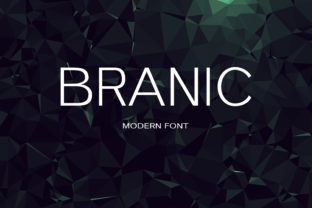
Branic: A Modern Sans Serif Rooted in Sign Painting Tradition
Typography isn’t just about letters—it’s about voice, intention, and presence. When you choose a typeface like Branic, you’re not selecting mere shapes on a screen. You’re choosing a visual language shaped by hand-painted storefronts, weathered brick walls, and decades of artisanal craft—refined for today’s digital clarity and design discipline.
Where Craft Meets Code
Branic draws direct inspiration from traditional American sign painting: the confident strokes of brush-lettered headlines, the subtle weight shifts in hand-rendered capitals, the quiet confidence of letterforms built to be seen from across the street—not scrutinized at 200% zoom. But Branic doesn’t replicate nostalgia. It interprets it. Every glyph is redrawn with geometric precision, balanced proportions, and optical consistency—ensuring sharp rendering at any size, from mobile UI buttons to billboard-scale hero text.
That duality—hand-informed yet digitally native—is what makes Branic feel both grounded and forward-looking. Its uppercase letters carry the upright authority of classic signage, while its lowercase forms introduce gentle humanist curves and open apertures that improve readability in body copy. The result? A sans serif that avoids sterile uniformity without slipping into decorative excess.
Clean, Not Cold: The Power of Intentional Minimalism
“Minimal” is often misused in design. Some fonts strip away so much personality they become forgettable. Branic takes a different path: minimal in structure, rich in nuance. Its stroke contrast is restrained—not zero, not dramatic—but just enough to guide the eye naturally through words. Letter spacing is generous but purposeful; x-height is tall enough for legibility on small screens, yet balanced to avoid visual heaviness in longer paragraphs.
This intentional minimalism translates directly into real-world utility. Designers report faster layout decisions when using Branic because its rhythm feels intuitive—not forced. There’s no need to overcompensate with tracking adjustments or leading tweaks. Its vertical metrics are finely tuned for web use, aligning cleanly with CSS line-height defaults and responsive frameworks. That means less time debugging text overflow on cards or navigation bars—and more time refining the message itself.
How Branic Fits Into Real Design Workflows
- Brand identity systems: Branic works exceptionally well as a primary display face paired with a neutral, highly legible companion for body text (think Inter or IBM Plex Sans). Its strong personality holds up in logos, app icons, and social banners—without overwhelming supporting content.
- Digital product interfaces: Because of its clear letterforms and consistent spacing, Branic shines in dashboard headers, feature announcements, and call-to-action buttons. Its medium and bold weights have enough presence to command attention, while its regular weight remains crisp and readable at 14–16px.
- Editorial and publishing: While traditionally a display font, Branic’s thoughtful lowercase design and generous character set—including full Latin-1 support, discretionary ligatures, and true small caps—make it viable for short-form editorial use: magazine covers, newsletter subject lines, or pull quotes embedded in long-form articles.
One designer recently shared how switching their SaaS landing page headline typeface from a generic geometric sans to Branic increased scroll depth by 12%. Not because Branic “converted better”—but because its warmth and clarity made visitors pause, read, and trust the message faster. That’s the quiet impact of typographic intention.
Why Designers Reach for Branic (and When They Might Pause)
Branic resonates most strongly with teams who value authenticity without sacrificing polish. If your brand leans into craftsmanship—whether you're a ceramics studio, an independent publisher, or a sustainable apparel label—Branic offers visual continuity between your physical packaging and digital touchpoints. Its roots in sign painting subtly echo values like honesty, skill, and permanence.
But Branic isn’t universally ideal—and that’s part of its strength. It’s not meant for dense legal disclaimers or multilingual interfaces requiring extensive diacritic support beyond Western European languages. Its charm lies in focused application: where typography plays a deliberate, expressive role—not just functional scaffolding.
Before adopting Branic, consider these practical checkpoints:
- Licensing scope: Branic is available in multiple licensing tiers—web-only, desktop + web, and extended for apps or merchandise. Make sure your intended use matches the license. For agencies managing multiple client sites, the multi-domain web license often delivers better long-term value than per-site purchases.
- Weight range needs: Branic currently ships in five carefully calibrated weights—Thin, Light, Regular, Medium, and Bold—with matching italics. It doesn’t include ultra-black or extra-light variants. If your system relies on extreme contrast for hierarchy, pair Branic with a complementary font for those edge cases—or rely on size and color instead.
- Load performance: At ~180 KB for the full variable-weight web font (WOFF2), Branic is leaner than many contemporary variable fonts. Still, if you only need headlines, loading just the Bold and Medium weights reduces payload significantly—especially when combined with
font-display: swapfor graceful fallback behavior.
Pairing Branic Thoughtfully
A great typeface earns its place not in isolation—but in conversation. Branic’s clean geometry and subtle warmth make it unusually flexible when pairing. Here’s what works—and why:
- With neutral sans serifs (e.g., Inter, Manrope): This is the most common and effective pairing. Branic handles headlines and branding elements; the neutral companion handles interface labels, captions, and body text. The contrast is clear but harmonious—like a well-edited photo series where one image anchors the mood, and the others provide context.
- With warm serifs (e.g., IBM Plex Serif, Charter): Surprising but effective—especially for editorial or cultural brands. Branic’s sign-painting soul finds kinship with serifs that also honor tradition (but aren’t overly ornate). Just avoid high-contrast Didones; they clash tonally.
- Avoid overpairing: Don’t layer Branic with another strong personality font (e.g., a distressed display face or a quirky rounded sans). Its quiet confidence gets lost. Let it lead—and let supporting fonts recede gracefully.
More Than Aesthetic: What Branic Signals to Your Audience
Typography communicates before a single word is read. Choosing Branic tells people something subtle but meaningful: *We respect craft. We value clarity over clutter. We’re modern—but not at the expense of humanity.*
That resonance matters in crowded digital spaces. When users encounter Branic in a fintech app’s onboarding flow, they subconsciously register stability and approachability—not cold automation. When it appears on a boutique hotel’s reservation page, it whispers attention to detail and tactile experience. It bridges the gap between “designed” and “made.”
And that’s where Branic distinguishes itself from purely algorithmic fonts. It’s not generated by AI training data—it’s shaped by observation, revision, and reverence for how letters live in the real world. That human origin shows up in the way its ‘a’ opens, how its ‘t’ sits confidently on the baseline, and why its ampersand feels like a nod rather than an afterthought.
If you’ve been searching for a sans serif that feels both timeless and timely—if you want typography that supports your message without shouting over it—Branic isn’t just an option. It’s an invitation to design with intention, craft with care, and communicate with quiet confidence.