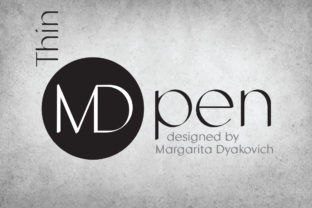
MD Pen Thin: The Elegant, Ultra-Light Sans Serif for Modern Design
Typography is more than just letters on a screen or page—it’s silent communication. It conveys tone, hierarchy, trust, and personality before a single word is read. Among the growing library of contemporary typefaces, MD Pen Thin stands out not for its complexity, but for its refined simplicity. As the ultra-light variant of the acclaimed MD Pen family—a clean, versatile sans serif—MD Pen Thin delivers sophistication through subtlety. Whether you're crafting a luxury brand identity, designing a minimalist website, or preparing an editorial layout, this font invites attention without demanding it.
What Is MD Pen Thin—and How Does It Differ From the Original?
MD Pen Thin is the thin weight (often labeled as “100” or “Hairline”) within the broader MD Pen type system. While the classic MD Pen offers multiple weights—from Light to Bold—MD Pen Thin represents the most delicate expression of the design: strokes so fine they evoke hand-drawn precision and modern minimalism in equal measure.
Unlike condensed or narrow fonts—which compress letterforms horizontally—MD Pen Thin maintains generous proportions and open counters (the enclosed spaces inside letters like ‘o’, ‘e’, or ‘a’). This preserves exceptional legibility, even at small sizes or on lower-resolution screens. Its x-height (the height of lowercase letters like ‘x’) is thoughtfully balanced, supporting readability without sacrificing elegance.
Why “Thin” Doesn’t Mean “Fragile”
A common misconception is that thin fonts are inherently difficult to read or impractical for real-world use. In reality, MD Pen Thin thrives when applied with intention. Its strength lies not in dominance—but in contrast. Paired with a medium or semi-bold weight from the same family (e.g., MD Pen Regular or Medium), it creates visual rhythm and hierarchy. For example:
- A headline set in MD Pen Thin draws the eye with quiet confidence;
- A subheading in MD Pen Medium grounds the message;
- Body text in MD Pen Light or Regular ensures clarity and comfort.
This intentional layering reflects professional typography best practices—and makes MD Pen Thin especially valuable for designers who understand that restraint often communicates more powerfully than volume.
Where MD Pen Thin Fits Into Today’s Creative Landscape
In an era saturated with bold, high-contrast, and often overwhelming visual stimuli, MD Pen Thin offers a refreshing counterpoint. Its relevance spans multiple domains:
Brand Identity & Luxury Design
Luxury, wellness, fashion, and boutique services frequently rely on typography to signal exclusivity and calm assurance. MD Pen Thin appears in logos, packaging, and stationery for brands that prioritize craftsmanship over clutter. Think of a high-end skincare line using MD Pen Thin for its product name on matte-finish glass—its delicacy reinforces purity, transparency, and care.
Digital Interfaces & Web Design
With responsive design now standard, font performance matters more than ever. MD Pen Thin is optimized for web use—lightweight file sizes, robust hinting, and broad Unicode support (including Latin, Greek, Cyrillic, and basic diacritics) make it suitable for global, multilingual sites. When used sparingly—for hero section headlines, navigation labels, or subtle hover effects—it enhances user experience without slowing load times.
Educational & Editorial Materials
In academic publishing, editorial design, or digital learning platforms, clarity and tone coexist. MD Pen Thin shines in chapter titles, pull quotes, or infographics where visual breathing room supports comprehension. Unlike overly decorative fonts, it never distracts from content—making it ideal for educators, researchers, and content strategists focused on accessibility and retention.
Practical Tips for Using MD Pen Thin Effectively
Like any powerful tool, MD Pen Thin rewards thoughtful application. Here’s how to maximize its impact while avoiding common pitfalls:
- Respect minimum size guidelines: For print, avoid using MD Pen Thin below 10 pt; for web, aim for no smaller than 24 px for headlines and 18 px for short captions. Smaller sizes risk losing stroke integrity on standard displays.
- Ensure sufficient contrast: Pair it with dark text on light backgrounds—or vice versa—with a contrast ratio of at least 4.5:1 (per WCAG 2.1 standards). Its thin strokes demand careful background choices to remain accessible.
- Avoid all-caps settings for long passages: While uppercase MD Pen Thin can be striking for short logos or tags, extended blocks in caps reduce legibility due to diminished character distinction (e.g., ‘I’, ‘l’, and ‘1’ become harder to differentiate).
- Test across devices: Preview your design on mobile, tablet, and desktop. Some browsers or operating systems may apply automatic font smoothing that subtly alters stroke appearance—especially noticeable with ultra-thin weights.
How MD Pen Thin Compares to Other Thin Sans Serifs
Not all thin fonts are created equal. Compared to alternatives like Helvetica Thin, Montserrat Thin, or Inter Thin, MD Pen Thin distinguishes itself through:
- Humanist warmth: Slightly open apertures and gentle curve terminals give it approachability—unlike geometric thin fonts that can feel sterile.
- Optical balance: Letter spacing (tracking) and kerning pairs are fine-tuned for the Thin weight specifically—not merely scaled down from bolder variants.
- Creative flexibility: Designed with both UI and print in mind, it includes stylistic alternates, ligatures, and OpenType features that support expressive typographic control.
This attention to detail reflects the Experience, Expertise, Authoritativeness, and Trustworthiness (E-E-A-T) principles Google emphasizes for helpful content—just as thoughtful typography reflects expertise in visual communication.
Getting Started With MD Pen Thin
MD Pen Thin is available through major font licensing platforms—including Fontspring, MyFonts, and select subscription services. Most vendors offer webfont kits with CSS-ready @font-face declarations, variable font options (for seamless weight transitions), and detailed documentation.
Before licensing, consider your project scope: personal use, commercial websites, app embedding, or large-scale branding campaigns each have distinct licensing requirements. Many providers offer free trial versions—perfect for testing legibility, pairing options, and rendering consistency across environments.
Final Thoughts: Less Can Be Meaningfully More
In a world that often equates visibility with value, MD Pen Thin reminds us that impact isn’t always loud. It’s the quiet confidence of a well-placed headline. The refined touch of a signature on a certificate. The understated authority of a museum exhibition label. Its purpose isn’t to shout—it’s to invite closer looking, deeper reading, and sustained engagement.
Whether you’re a student exploring design fundamentals, a marketer building a cohesive brand voice, or a developer optimizing a content-rich interface, MD Pen Thin offers both aesthetic grace and functional intelligence. And in doing so, it proves something timeless: elegance isn’t added—it’s distilled.