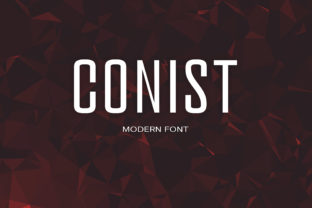
Conist: A Clean, Modern Sans Serif Rooted in Sign Painting Tradition
Conist isn’t just another sans serif font—it’s a thoughtful bridge between hand-painted letterforms and digital precision. Inspired by the rhythm, weight shifts, and quiet confidence of traditional sign painting, Conist translates those human qualities into a crisp, minimalist typeface that feels both intentional and approachable. It doesn’t shout; it holds space with clarity. That balance—warmth without ornament, structure without rigidity—is why designers, founders, educators, and even small-business owners are reaching for Conist when they need typography that supports meaning, not distracts from it.
Where Conist Fits Naturally—Not Just Where It Looks Good
Typography works best when it disappears just enough to let content breathe—while still reinforcing tone and intent. Conist excels in contexts where authenticity, readability, and subtle distinction matter more than trend-chasing. Here’s where real people are using it right now:
- Small-batch product branding: Think ceramic studios, local roasters, or handmade skincare lines. One Portland-based candle maker switched from a generic geometric sans to Conist for their labels—and immediately noticed customers commenting on how “calm” and “trusted” the packaging felt. The slight modulation in stroke weight (a nod to brush pressure) adds tactile warmth without sacrificing legibility at small sizes.
- Editorial design for digital-first publications: A newsletter focused on sustainable living uses Conist for body text across its web and email layouts. Its generous x-height and open counters keep reading smooth on mobile screens, while the restrained personality avoids competing with photography-heavy storytelling.
- Internal tools and dashboards: A health-tech startup chose Conist for its clinician-facing interface—not because it’s flashy, but because its consistent spacing and clear letterforms reduce cognitive load during high-stakes workflows. Lowercase “l”, uppercase “I”, and numeral “1” are distinctly differentiated—a small detail that prevents misreading in time-sensitive settings.
- Academic and nonprofit communications: Universities updating their faculty recruitment materials found Conist struck the right note: professional but not corporate, serious but not stiff. Its neutrality allows institutional voice—not font personality—to lead.
Who Benefits—and How Their Needs Shape the Choice
Conist serves different users in different ways—not because it’s flexible in a chameleon-like sense, but because its core traits respond meaningfully to specific priorities.
Designers appreciate how Conist simplifies hierarchy. With only two weights (Regular and Bold) and no italics, there’s less decision fatigue—and more room to explore layout, color, and whitespace as expressive tools. One freelance designer shared that she now uses Conist as her “default starting point” for brand systems where clients value craft over complexity. It’s not limiting; it’s clarifying.
Founders and solopreneurs often lack dedicated design support. Conist removes guesswork: it pairs effortlessly with neutral palettes, scales cleanly across business cards to websites, and renders reliably on Windows, macOS, and mobile OSes. No kerning tweaks needed for headlines. No font substitution anxiety in PDFs. That reliability saves hours—and reduces stress when launching a site or printing first-run packaging.
Educators and workshop facilitators use Conist in slide decks and handouts because students consistently report better retention of information set in it versus tighter, higher-contrast alternatives. The gentle contrast and balanced proportions support sustained focus—especially important in hybrid or screen-heavy learning environments.
Practical Considerations Before You Commit
Like any thoughtful tool, Conist shines brightest when matched to the right job. Ask yourself these questions before adopting it broadly:
- Is your audience scanning—or settling in? Conist is optimized for moderate-to-long reading, not ultra-rapid skimming. If your primary use is app notifications or social banners under three words, a tighter, more condensed sans might serve better.
- Do you need extensive language support? Conist covers Latin-based languages thoroughly—including extended diacritics for French, Spanish, Vietnamese, and Turkish—but doesn’t yet include Cyrillic, Greek, or CJK glyphs. If multilingual publishing is core to your work, verify coverage for your required scripts.
- What’s your output environment? While Conist performs beautifully on screen and in high-res print, its clean terminals and modest contrast mean it can soften slightly in low-DPI environments (e.g., older projectors or thermal receipt printers). Test in your actual delivery context—not just in design software.
- Are you pairing it with other typefaces? Conist plays well with both serif and monospace companions—but avoid pairing it with fonts that share its same structural DNA (e.g., other “sign-inspired” sans serifs). Contrast creates harmony. Too much similarity creates visual static.
Strengths That Show Up in Daily Use
What makes Conist feel like a quiet upgrade rather than a stylistic detour? It’s in the details that accumulate into real impact:
- Optical sizing baked in: The Regular weight has been fine-tuned for 14–18px body copy; the Bold is adjusted for headlines down to 24px—so you’re not fighting rendering inconsistencies across sizes.
- No forced personality: Unlike fonts that lean heavily into quirk or austerity, Conist stays centered. That means it adapts to your brand voice instead of imposing one. A playful brand can animate it with color and layout; a conservative one can ground it with ample margin and muted tones.
- Performance-friendly: Lightweight file size (under 60KB for the full family) means faster loading—especially valuable for sites targeting global audiences or users on slower connections.
A Few Realistic Notes on Its Range
Conist isn’t trying to be everything. It doesn’t offer variable axes, decorative alternates, or ultra-narrow widths—and that’s intentional. If your project demands extreme typographic expression (think experimental art books or luxury campaign microsites with layered textures), you’ll likely reach beyond Conist. Likewise, if your workflow depends heavily on script or display variants, its focused family may feel too lean.
But for the vast majority of communication needs—digital interfaces, printed collateral, presentations, packaging, editorial layouts—Conist delivers consistency, calm, and quiet confidence. It’s the kind of typeface that doesn’t draw attention to itself… until someone asks, “What font is this?”—and then remembers it.
That’s the sign of typography that works: not as decoration, but as quiet stewardship of meaning.