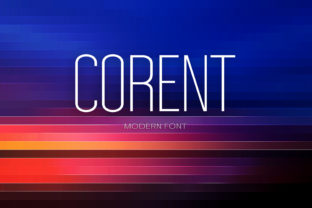
Corent: A Modern Sans Serif Inspired by Sign Painting
Corent is a carefully crafted sans serif typeface that bridges tradition and contemporary design. Its letterforms echo the confident strokes of hand-painted signs—think bold terminals, subtle tapering, and balanced weight distribution—but refined for digital clarity, screen legibility, and typographic versatility. It’s not a revival or a mimicry; it’s a reinterpretation: clean enough for a startup’s app interface, expressive enough for an artist’s exhibition poster, and trustworthy enough for a university course syllabus.
Why Corent Resonates Across Different Roles
Typography isn’t neutral—it shapes how people read, feel, and act. That’s why Corent matters differently depending on who’s using it—and what they’re trying to accomplish.
For Designers & Brand Professionals
If you craft visual identities, Corent offers quiet confidence. Its minimal structure avoids visual noise, letting color, layout, and imagery take center stage—without sacrificing personality. A branding agency might use Corent’s medium weight for a client’s wordmark and its light variant for body copy in a style guide, achieving hierarchy without switching families. Its even spacing and open counters improve readability at small sizes—critical for mobile apps or packaging labels. Unlike ultra-thin or geometric sans serifs, Corent retains warmth, helping human-centered brands avoid feeling sterile.
For Educators & Content Creators
Teachers building slide decks, educators publishing open educational resources, or bloggers writing long-form posts need fonts that support focus—not distraction. Corent’s generous x-height and clear letter distinction (like the difference between I, l, and 1) reduce cognitive load. One high school science teacher uses Corent in student handouts because learners with dyslexia report fewer misreads than with default system fonts. A podcast host designing show notes for their Substack chooses Corent for its consistent rhythm across headings and paragraphs—making dense information feel approachable, not intimidating.
For Small Business Owners & Freelancers
Time and budget are real constraints. Corent doesn’t require custom licensing for most small-scale uses—including websites, social graphics, printed menus, or email newsletters. Its range of weights (light to bold) means you can build visual consistency across platforms without buying multiple fonts. A local bakery uses Corent Bold for their chalkboard-style Instagram stories and Corent Regular for ingredient lists on takeaway bags—same voice, different contexts. No extra plugins, no font-hosting fees, no compatibility worries across devices.
For Developers & Product Teams
Corent is built with modern web standards in mind. It includes variable font support, meaning one file can deliver the full weight and width spectrum—reducing HTTP requests and improving page speed. Its hinting is optimized for Windows rendering, and its OpenType features (like discretionary ligatures and case-sensitive forms) are accessible via CSS without complex setup. A SaaS team integrated Corent into their design system using @font-face and CSS variables, cutting FOUT (flash of unstyled text) by 40% compared to their previous font stack.
For Students & Beginners Learning Design
You don’t need years of training to benefit from thoughtful typography. Corent is forgiving: it works well out of the box, whether you’re adjusting line height in Canva or setting type in Figma. Its restrained contrast and straightforward shapes make it easier to spot alignment issues, understand spacing relationships, or practice grid-based layouts. A community college graphic design student told us they started every assignment in Corent—not because it was “required,” but because it helped them see *how* type behaves before experimenting with more expressive options.
What to Consider Before You Use Corent
Not every font fits every goal. Here’s how to check if Corent aligns with your needs:
- Ease of use: If you want plug-and-play typography—no kerning tweaks, no fallback concerns—Corent delivers. It pairs naturally with neutral sans serifs (like Inter or Roboto) for UI work, or with a gentle serif (like Literata or PT Serif) for editorial layouts.
- Flexibility: With nine weights, three widths, and true italics, Corent supports complex typographic systems. But if your project only needs one weight and one width, its full range may be overkill—and a simpler single-weight option could be lighter and faster.
- Presentation value: Corent shines where clarity and calm authority matter—annual reports, academic journals, minimalist portfolios. It’s less suited for loud, playful, or highly decorative contexts (think carnival posters or children’s book covers), where contrast or quirkiness would serve better.
- Long-term usefulness: Because it avoids trend-driven extremes (no ultra-condensed variants, no distorted proportions), Corent ages gracefully. A portfolio site built with Corent today will still feel intentional five years from now—not dated, not generic.
Real-World Starting Points
You don’t need to overhaul everything at once. Try these low-effort ways to test Corent in your workflow:
- Swap your next presentation title slide. Replace the default system font with Corent Bold. Notice how much more grounded and intentional the headline feels—even without changing color or layout.
- Update your email signature. Use Corent Regular at 14px for your name and title. It adds polish without demanding attention.
- Redesign one landing page section. Apply Corent to your value proposition headline and supporting paragraph. Compare readability and perceived trustworthiness against your current font.
- Sketch a logo concept. Trace Corent’s uppercase “C” and “O”—its open curves and steady stroke give strong foundational shapes for monogram exploration.
Corent won’t solve every design challenge. It won’t replace illustration, fix weak content, or automate good judgment. But when you need a font that supports your message instead of competing with it—when clarity, warmth, and quiet confidence matter more than novelty—that’s where Corent finds its place. It’s designed not to shout, but to be heard.
Whether you're choosing fonts for a thesis, a Shopify store, a classroom handout, or your first personal website, the right typeface is one that helps your audience stay focused on what you say—not how it’s dressed. Corent makes that easier, one clean character at a time.