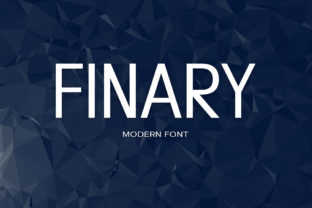
Finary: A Modern Sign-Painting Sans Serif
If you’ve ever paused at a hand-painted café sign—clean lines, confident curves, quiet authority—you’ll recognize the spirit behind Finary. It’s not just another sans serif font. It’s a thoughtful reinterpretation of traditional sign painting, distilled into a contemporary typeface that feels both grounded and forward-looking. No excessive contrast, no forced quirkiness—just balanced proportions, subtle stroke modulation, and an unmistakable sense of craft.
Finary is a premium font built for clarity and character. Its letterforms avoid mechanical uniformity: the ‘a’ has a gentle open counter; the ‘g’ features a closed, slightly tilted bowl; terminals taper with intention—not sharpness, but soft definition. These aren’t decorative flourishes. They’re functional details that guide the eye, support rhythm, and add warmth without sacrificing neutrality. That balance makes Finary unusually versatile: it reads effortlessly at small sizes in UI elements, yet commands attention as a display font on a book cover or storefront banner.
Where Finary Fits Naturally—Without Forcing It
This isn’t a “one-size-fits-all” typeface—but it fits where many others strain. Think of it as the quiet collaborator in your design toolkit.
- Brand identity: Finary works especially well for service-based businesses—consultancies, studios, wellness practices—that want to project calm competence without leaning into sterile minimalism. Its slight human touch avoids coldness, while its structure reassures.
- Editorial design: In magazine headers, newsletter subject lines, or chapter titles, Finary adds distinction without competing with body text. Paired with a neutral serif (like Adobe Garamond or Literata), it creates hierarchy that feels intentional, not arbitrary.
- Packaging design: On apothecary labels, ceramic studio tags, or small-batch food packaging, Finary conveys care and authenticity. It doesn’t shout “handmade,” but it doesn’t pretend to be digitally generated either—it occupies that honest middle ground.
- Social media graphics: Because its x-height is generous and spacing is generous by default, Finary remains legible even when scaled down for Instagram Stories or Pinterest pins—no need to overcompensate with bold weights or extra tracking.
- Web design: As a web font, Finary loads cleanly and renders consistently across devices. Its variable axis (if included in your license) lets you fine-tune weight and width for responsive headlines—tightening for mobile, expanding for desktop—without swapping families.
What Finary Does for Your Audience—Not Just Your Aesthetics
Typefaces don’t speak—but they signal. Finary signals approachability paired with precision. That duality affects how people perceive your work before they read a single word.
In logo design, using Finary suggests confidence without aggression. It doesn’t try to mimic handwriting or script fonts, so it avoids looking like a trend. Instead, it grounds a brand in consistency—whether you’re launching a podcast, redesigning a nonprofit’s website, or refreshing product packaging. Readers subconsciously register its even color and steady rhythm as trustworthy. That matters more than you might think: studies show users spend less time evaluating content when typography feels familiar and well-structured.
For content creators and bloggers, Finary helps differentiate your visual voice. If your audience sees the same sleek geometric sans across dozens of competitor sites, Finary stands out—not by being flashy, but by feeling considered. Its personality supports storytelling rather than overshadowing it.
And for small business owners managing their own branding? Finary reduces decision fatigue. You won’t need three display fonts and two alternates to get variety. Its family typically includes Light, Regular, Medium, Bold, and often an Italic—each engineered to harmonize, not clash. That means fewer hours spent testing pairings, and more time focused on messaging.
Practical Tips Before You License or Download
Finary is a commercial font, and licensing varies depending on use case. Here’s what to check before committing:
- Match the weight to your medium: Don’t assume Bold = better. For long-form web headers, Medium often delivers stronger readability than Bold—less visual noise, more breathing room. Test both at actual size on your target device.
- Review the character set: Does it include OpenType features like stylistic sets or discretionary ligatures? Not all versions do—and while they’re rarely essential, they can refine polish in high-touch projects like stationery or annual reports.
- Test real copy, not lorem ipsum: Try Finary with your actual brand name, tagline, and a sentence of body copy. Watch how letters like ‘r’, ‘y’, and ‘f’ interact. Some sans serifs tighten awkwardly around certain combinations—Finary handles most gracefully, but verify with your specific context.
- Pair thoughtfully—not automatically: Avoid defaulting to “sans + serif.” Try Finary with a low-contrast serif (e.g., PT Serif, Lora) or even a restrained slab (like Sentinel). For digital interfaces, test it against system fonts like Inter or Roboto in body text—its warmth complements neutrality without clashing.
- Check licensing scope: If you’re designing for a client, confirm whether your license covers commercial redistribution (e.g., embedding in a client’s Shopify theme or PDF brochure). Most reputable foundries offer clear tiered options—don’t guess.
A Final Note on Intentionality
Finary won’t fix weak messaging or inconsistent visuals. But when used with attention to spacing, scale, and context, it quietly elevates execution. It’s the kind of design asset that earns respect over time—not because it draws attention to itself, but because it makes everything around it feel more resolved.
Whether you're sketching a logo on paper, building a landing page in Webflow, or laying out a zine in InDesign, Finary rewards restraint. It doesn’t ask you to explain it. It simply supports what matters most: your idea, your voice, your audience’s experience.