Meet Melodramatic
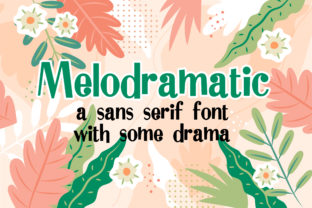
There’s a quiet confidence in Melodramatic—not loud, not flashy, but unmistakably present. It’s a sans serif font with soft curves tucked into corners, gentle swelling at terminals, and just enough roundness to feel approachable without sacrificing clarity. Think of it as the kind of typeface that walks into a room wearing minimalist sneakers and a well-cut blazer: contemporary, grounded, and effortlessly cool.
A Font That Breathes With Your Brand
Melodramatic isn’t built for body text or long-form reading—it’s a display font, designed to command attention in short bursts. Its personality lands somewhere between friendly and focused: warm enough for a handmade ceramics shop’s Instagram banner, sharp enough for a tech newsletter’s headline or a boutique publisher’s book cover. The subtle roundness gives it elasticity—it bends slightly toward playfulness without slipping into whimsy, and leans into sophistication without becoming stiff.
Unlike many modern sans serifs that chase neutrality (think ultra-thin weights or geometric rigidity), Melodramatic retains human rhythm. Letters like “a”, “e”, and “g” have open, easy shapes; “S” and “C” curve with quiet momentum. That warmth makes it unusually versatile across tone—from empathetic wellness content to bold creative studios—without needing stylistic gymnastics to fit.
Where Melodramatic Fits Best (and Where It Doesn’t)
This is where practicality matters most. Melodramatic shines in contexts where you’re speaking *to* someone—not just at them. That means:
- Logo design for lifestyle brands, indie publishers, or service-based businesses that value authenticity over polish (e.g., a yoga studio’s wordmark, a freelance editor’s business card)
- Editorial design for magazine covers, newsletter headers, or chapter titles—especially when paired with a clean, highly legible serif or neutral sans for body copy
- Social media graphics, particularly static posts or Stories where visual cohesion matters more than micro-legibility on tiny screens
- Packaging design for small-batch goods—soap labels, coffee bags, candle boxes—where tactile warmth and brand voice are inseparable
- Web design for hero sections, call-to-action buttons, or navigation items where size and spacing can be controlled
It’s less suited for dense UI interfaces, legal disclaimers, or multi-column print layouts where tight tracking and consistent x-heights matter more than character. And while it holds up beautifully at 36pt and above, don’t force it below 20pt in digital use—its charm lives in scale and breathing room.
How It Shapes Perception—Without Saying a Word
Typefaces aren’t neutral. They carry weight, pace, and subtext. Melodramatic subtly signals that your brand values craft over convenience, intention over automation. When used thoughtfully, it reinforces consistency—not by repeating the same shape, but by maintaining a recognizable *attitude*: calm energy, understated confidence, thoughtful restraint.
That impression directly affects audience engagement. A reader scanning a blog header set in Melodramatic doesn’t just register the words—they register a feeling: “This feels considered.” That builds trust faster than a generic system font ever could. In logo design, it helps differentiate a small business from competitors using overused fonts like Montserrat or Poppins—not by being obscure, but by being *distinctly tuned*.
And because it’s a premium font (not a free Google Font), its use often signals investment—in design, in storytelling, in how people experience your work. That perception isn’t about price—it’s about care.
Testing & Pairing: Real-World Tips
Before committing, test Melodramatic in context—not just as a sample word, but as part of your actual layout. Try it in three places: a headline next to your current body font, a mock social post, and a simplified version of your logo lockup. Does it hold its own? Does it feel like a natural extension of your voice—or does it distract?
For pairings, lean into contrast. Melodramatic’s soft geometry pairs cleanly with structured serifs like Merriweather or EB Garamond for editorial projects. For digital-first brands, try it with a crisp, low-contrast sans like Inter or Work Sans—just ensure your body font has generous letter-spacing and line-height to avoid visual competition.
Avoid pairing it with other rounded sans serifs (like Nunito or Quicksand)—the similarities blur distinction. And skip script or handwritten fonts unless you’re aiming for deliberate tension (e.g., a wedding invitation where Melodramatic sets the formal name and a delicate script handles “&” or “RSVP”).
Licensing, Styles, and What to Check Before You Use It
Melodramatic is a commercial font, meaning you’ll need an appropriate license for your use case. Most foundries offer clear options: desktop (for design files), web (for live sites via @font-face), and app/embedding licenses. If you’re a freelancer delivering assets to a client, confirm whether their license covers redistribution—or if they need to purchase their own.
The family typically includes Regular and Bold weights, sometimes with an italic variant. There’s no Light or ExtraBold, so don’t expect extreme typographic range. That’s intentional: Melodramatic works best when used deliberately, not stretched across every possible weight. Check the character set too—some versions include extended Latin support, others stop at basic Western European. If you work with multilingual clients or publish globally, verify coverage before finalizing.
Also worth noting: Melodramatic isn’t available on Adobe Fonts or Google Fonts. You’ll source it directly from the designer or a trusted foundry. That means no auto-updates—but also no risk of sudden licensing changes or removal mid-project.
Final Thought: It’s Not About Trend, It’s About Fit
Melodramatic won’t solve vague branding problems or replace strong strategy. But if you’re refining a brand identity, launching a new product line, or redesigning a site where tone matters as much as function—it’s a smart, human-scaled tool. It works because it’s designed to serve communication, not just occupy space.
Use it where you want people to pause, not skim. Where warmth and clarity coexist. Where “contemporary coolness” isn’t a pose—it’s just how you show up.