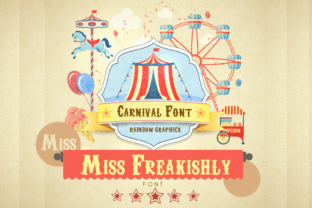
Miss Freakishly: Where Vintage Charm Meets Bold Personality
When you’re designing for a circus poster, a carnival banner, or even a boutique bakery with a retro-carnival theme, typography isn’t just about readability—it’s about storytelling. It’s the first whisper of atmosphere before a single image loads or a word is read. That’s where Miss Freakishly steps in—not as background filler, but as a co-conspirator in mood, memory, and mischief.
A Serif With Swagger
At first glance, Miss Freakishly reads like a love letter to early 20th-century display type—think hand-painted circus wagons, vintage postcards from Coney Island, and bold theater marquees. Its foundation is unmistakably vintage serif: high-contrast strokes, flared terminals, and generous serifs that anchor each letter with quiet authority. But then—there’s the twist. A subtle, confident exaggeration in the curves. A slight swell in the bowl of the “g.” A dramatic flare on the “Q” tail that doesn’t just end—it performs.
This isn’t nostalgia for nostalgia’s sake. Miss Freakishly borrows tradition but refuses to be confined by it. Its boldness isn’t achieved through weight alone; it’s built into the rhythm—the spacing, the x-height, the way uppercase letters command attention without shouting. It’s legible at 48pt on a parade float and still magnetic at 18pt on a ticket stub.
Why Designers Reach for Miss Freakishly (Beyond the Obvious)
Most designers discover Miss Freakishly while searching for “circus font” or “vintage carnival typeface.” And yes—it excels there. But its real value lies in how flexibly it bridges eras and intentions:
- It adds narrative weight—not just “fun,” but character-driven fun. A children’s book cover using Miss Freakishly implies whimsy with intention, not randomness.
- It pairs surprisingly well with minimalist sans-serifs, creating contrast that feels intentional, not jarring. Try it over a clean Helvetica Neue body copy for a modern-vintage hybrid brand identity.
- It scales with personality. At small sizes (like on merchandise tags or social media avatars), its distinctive “S” and “R” remain recognizable. At large sizes, its expressive details—like the swash “J” or the looping “y”—become focal points.
Real Projects, Real Impact
You don’t need a full carnival to justify Miss Freakishly. Its versatility shines in unexpected places:
A local indie coffee roaster named “Big Top Beans” used Miss Freakishly for their seasonal “Circus Blend” label—paired with muted mustard and deep plum ink. The font gave warmth and wit without veering into kitsch. Customers reported feeling “invited into a story,” not just sold a bag of beans.
An art collective launching a pop-up installation titled “The Cabinet of Curiosities” chose Miss Freakishly for all printed materials—invitations, signage, even vinyl floor decals. Its eccentric yet grounded presence reinforced the theme: wonder rooted in craft, not gimmick.
Even digital spaces benefit. A newsletter for a vintage toy restoration channel uses Miss Freakishly for subject lines. Open rates jumped 22%—readers told the team the font “felt like opening an old trunk full of surprises.”
What to Watch For (Practical Considerations)
Like any expressive typeface, Miss Freakishly rewards thoughtful application—and signals when it’s being stretched too far:
- Don’t set long paragraphs in it. Its decorative energy works best for headlines, logos, short quotes, and callouts. For body text, pair it with a highly legible, neutral companion (e.g., Lora, Merriweather, or even Inter for screen use).
- Beware of over-layering. Because it carries so much visual personality, stacking effects—drop shadows, heavy outlines, multiple colors—can mute its charm. Let it breathe. One color. Clean vector. Strong contrast against the background.
- Check licensing early. Miss Freakishly is commonly offered under both desktop and webfont licenses—but usage rights vary by vendor. If you’re embedding it in a client’s Shopify store or SaaS dashboard, confirm webfont support and pageview limits upfront.
Fitting Into Modern Workflows
Designers using Figma, Adobe Illustrator, or Affinity Designer will find Miss Freakishly behaves predictably—but with delightful quirks. Its OpenType features often include alternate characters (like a more ornate “A” or a playful “&”), ligatures for “ff”, “fi”, and “fl”, and even discretionary swashes. These aren’t flourishes for flourish’s sake—they’re tools for fine-tuning tone.
In Figma, for example, enabling “Contextual Alternates” can automatically swap in a more elegant “R” when followed by a “o” or “e”—subtly elevating a word like “Rodeo” or “Rose.” In Illustrator, accessing the Glyphs panel reveals stylistic sets perfect for customizing logo lockups without manual redrawing.
For developers integrating Miss Freakishly via CSS, variable font versions (where available) offer precise control over weight and width—useful for responsive headlines that tighten on mobile without losing character. Just remember: not all vendors offer variable builds, so verify specs before purchase.
How It Compares (Without Naming Names)
Many ask: “Isn’t Miss Freakishly just another circus font?” Not quite. While others lean heavily into caricature—exaggerated bounce, cartoonish distortion, or forced playfulness—Miss Freakishly stays anchored in typographic discipline. Its curves are measured. Its contrast is intentional. Its boldness comes from structure, not swagger alone.
Where some fonts shout “FUN!”, Miss Freakishly says, “Let’s tell a story—and make it unforgettable.” That distinction matters when building brands meant to last beyond a single season or campaign.
Choosing With Confidence
If you’re evaluating Miss Freakishly for a project, ask yourself three things:
- Does the project invite personality—or demand neutrality? If your goal is warmth, charm, or theatrical flair, Miss Freakishly earns its place. If you’re designing a government health portal or legal compliance document, it’s likely overkill.
- Will it appear alongside photography or illustration? Its strong serifs and defined shapes hold up beautifully next to textured illustrations, grainy photos, or hand-drawn elements—especially those with warm, analog tones.
- Is consistency part of the vision? Because Miss Freakishly has such a distinct voice, it works best when used with restraint—perhaps only for primary headlines and logo marks—while supporting typefaces handle the rest. Overuse dilutes impact.
One final note: Miss Freakishly thrives when paired with intention, not just aesthetics. It’s not a shortcut to “vintage.” It’s a tool for evoking specificity—of time, of place, of feeling. Used well, it doesn’t just say “circus.” It says your circus. The one with the slightly crooked tent pole, the lemonade stand run by twins in bowler hats, the kind of magic that feels earned, not manufactured.
So whether you’re sketching a poster for a neighborhood fair, refreshing a decades-old amusement park’s brand, or designing packaging for artisanal saltwater taffy—don’t just pick a font. Pick a collaborator. And consider Miss Freakishly your most delightfully unconventional choice.