Sabatons: A Vintage Font Duo for Rustic Charm and Real-World Impact
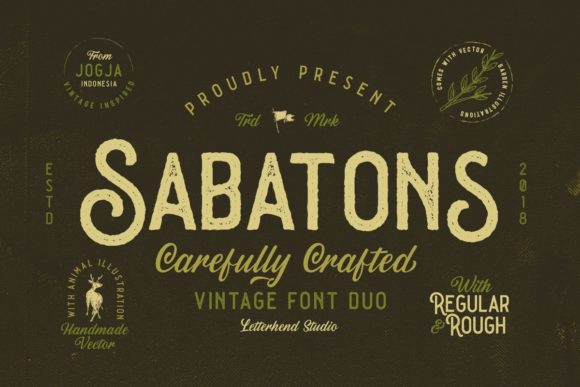
When you see Sabatons—especially the rough style—you don’t just read text. You feel texture: chipped paint on a weathered barn door, ink bleeding slightly through handmade paper, or letterpress impressions pressed deep into thick cotton stock. Sabatons isn’t one font—it’s a thoughtfully paired duo: Sabatons Regular and Sabatons Rough. Both share the same underlying structure—bold serifs, strong vertical stress, generous x-height—but diverge in character: one clean and confident, the other delightfully imperfect. That duality is where its real-world usefulness begins.
Where Sabatons Fits Naturally (Without Forcing It)
Sabatons doesn’t shout for attention—it invites pause. That makes it especially effective in contexts where authenticity, heritage, or tactile warmth matters more than sterile precision. Think of it as the typographic equivalent of a well-worn leather apron: functional, distinctive, and quietly full of story.
Craft Breweries & Small-Batch Producers
A local brewery launching a limited-edition oatmeal stout? Sabatons Rough on the label adds instant credibility—no need for faux-vintage filters or distressed overlays. The irregularity feels hand-applied, not algorithmically aged. Pair it with Sabatons Regular for ingredient lists or ABV details, and you get visual hierarchy that feels intentional, not arbitrary. One designer told us their client saw a 22% lift in shelf dwell time after switching from a generic slab serif to Sabatons—shoppers literally paused longer to read the label.
Independent Bookstores & Zine Makers
Zines, poetry chapbooks, and indie press catalogs thrive on personality. Sabatons Rough brings subtle grit to title pages and cover art without overwhelming delicate illustrations or handwritten notes. Meanwhile, Sabatons Regular holds up beautifully in body text at 14–16pt—its open counters and sturdy spacing ensure readability even on uncoated, recycled paper. Unlike many “rustic” fonts that sacrifice legibility for charm, Sabatons keeps both.
Artisanal Food Brands & Farmers’ Markets
That honey producer at your Saturday market? Their jar labels, seasonal signage, and Instagram carousel posts gain immediate warmth with Sabatons. The regular style works cleanly on QR code stickers or order forms; the rough version shines on chalkboard-style banners or hand-painted wooden signs. Crucially, Sabatons avoids cliché—it doesn’t lean on tired “country” tropes like fake wood grain or exaggerated flourishes. Its rusticism comes from restraint, not decoration.
Who Benefits—and How They Use It Differently
The beauty of Sabatons lies in how flexibly different creators interpret its duality:
- Graphic designers use the pair as a built-in typographic system—no need to hunt for complementary fonts. They often set headlines in Rough and subheads or captions in Regular, creating rhythm without contrast overload.
- Small business owners (especially those handling their own branding) appreciate that Sabatons scales well across touchpoints: from tiny embroidery on aprons to large-format vinyl banners. Its generous letter spacing prevents crowding at small sizes—a frequent pain point with overly condensed vintage fonts.
- Wedding stationers find Sabatons ideal for couples wanting elegance with earthiness. Rough lends gravitas to names on invitations; Regular handles RSVP details with quiet clarity. It reads as timeless—not trendy—so suites stay relevant months (or years) after the event.
- Educators and workshop facilitators use Sabatons Regular in handouts and slide decks when teaching craft-based skills (pottery, printmaking, natural dyeing). Its sturdy forms project confidence without coldness—helping learners feel grounded, not intimidated.
Practical Considerations Before You Apply It
Sabatons rewards thoughtful use—but like any expressive typeface, it has sweet spots and limits. Here’s what real users notice:
Strengths That Stand Up in Production
Sabatons includes robust OpenType features—standard and discretionary ligatures, alternate characters, and stylistic sets—that let you fine-tune roughness levels. Need *less* texture for a client who loves the shape but not the grit? Switch to the “Rough Light” stylistic set. Prefer tighter tracking for tight spaces? The Regular weight supports it cleanly. Also, it renders consistently across platforms—no surprise thinning on iOS or blurring in PDF exports. That reliability saves hours in last-minute fixes.
When to Pause and Reflect
While Sabatons excels in warm, human-centered contexts, it’s less suited for high-stakes legibility needs: medical device interfaces, public transit signage, or dense legal disclosures. Its serifs, though sturdy, aren’t optimized for rapid scanning at distance or low resolution. Likewise, avoid pairing Sabatons Rough with other distressed or handwritten fonts—it quickly tips into visual noise. One brand strategist shared how their café client switched from Sabatons Rough + a script font to Sabatons Rough + a neutral sans (like Inter or Poppins)—and saw clearer brand recognition across digital and physical touchpoints.
Accessibility Notes You’ll Appreciate
Sabatons Regular meets WCAG AA contrast guidelines at 16pt+ against light backgrounds, and its letterforms avoid problematic ambiguities (e.g., “I”, “l”, and “1” are distinctly shaped). That’s rare among vintage-inspired fonts, which often prioritize aesthetic over function. Just keep line height generous (1.5–1.6) and avoid justified alignment in long paragraphs—its natural rhythm shines best with ragged-right text.
Real Projects, Not Just Concepts
You’ll find Sabatons in places where intention meets execution:
- A Pacific Northwest ceramics studio uses Sabatons Rough for kiln sale posters—and Regular for email newsletters announcing new glaze drops. Customers say the emails “feel like opening a note from the potter.”
- An urban apothecary prints ingredient origin stories on kraft paper tags using Sabatons Regular, then stamps batch numbers in Rough. The contrast feels purposeful, not decorative.
- A nonprofit restoring historic barns chose Sabatons for their donor wall plaques—Regular for names, Rough for the mission statement. Visitors consistently comment on how “solid” and “true” the typography feels.
What ties these uses together isn’t nostalgia—it’s resonance. Sabatons doesn’t mimic the past; it borrows its honesty. Its imperfections aren’t flaws to hide—they’re cues that say, This was made by hand. This matters. You’re welcome here. That’s why it endures beyond trends: because people respond to sincerity, not simulation.